
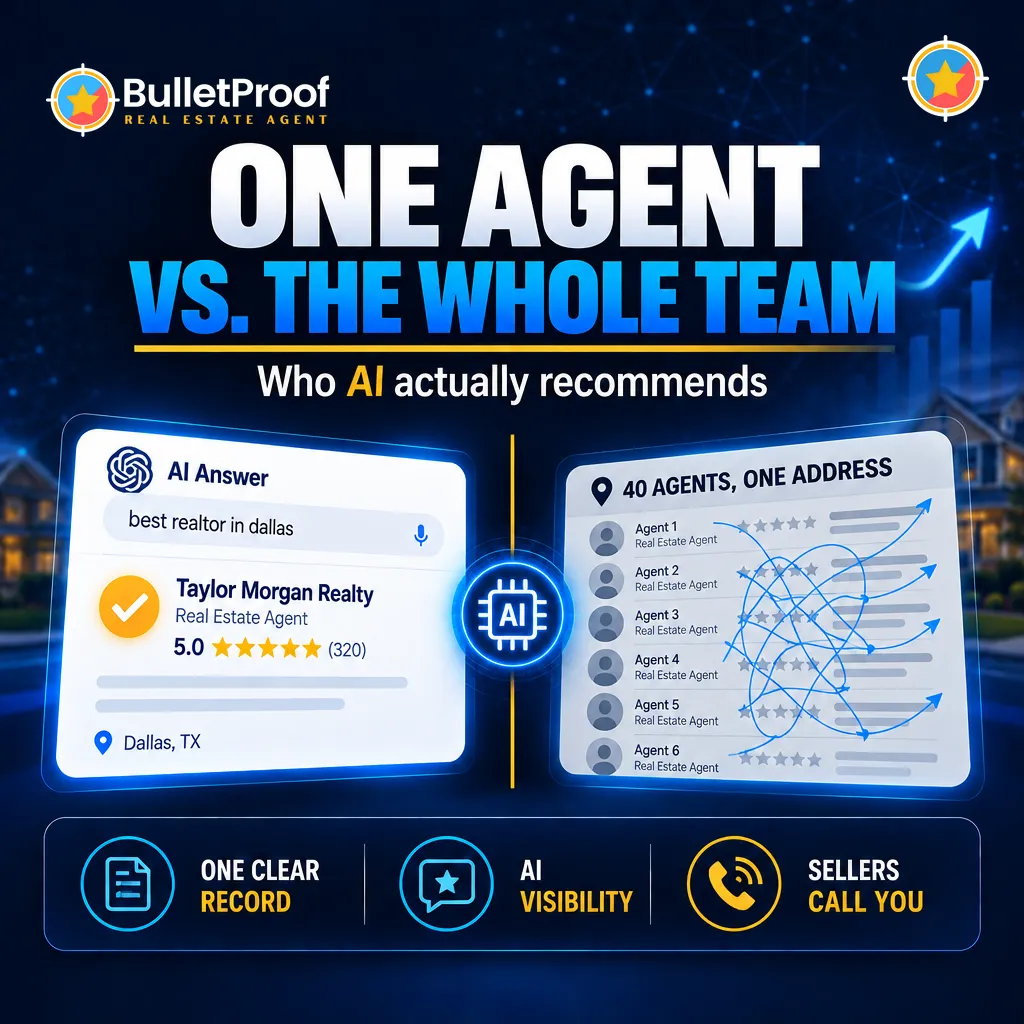
Solo Agent vs. Big Team: Who AI Actually Recommends
You've had this thought. Maybe this month.
You're solo, or you're three people and a part-time assistant. Across town there's a team with 40 agents, a marketing director, a billboard on the highway and a budget you couldn't match if you sold every listing you'll ever take. And somewhere in the back of your head is the quiet assumption that online visibility is a game they've already won, because of course it is. They're bigger.
Am I close?
Here's the part nobody tells you. In AI search, size is not the advantage. Clarity is. And clarity is much easier for one person than for forty.
Machines don't recommend the biggest agent
Machines don't recommend the best agent. They recommend the one they understand.
Read that again with a team in mind. A 40-agent brokerage is, to a machine, forty overlapping identities sharing one address, one phone number, and one brand name. Forty profiles. Forty sets of reviews, unevenly collected. Half a dozen websites and agent subpages that contradict each other. The billboard doesn't help. There is no field for billboard.
You, on the other hand, are one name. One market. One profile. One phone number. One story that can be written down in a paragraph without anyone having to guess who they'd actually be working with.
Which one of those is easier to describe to a seller in three sentences?
Evan Downey, Dallas, one agent
Evan Downey is a solo eXp agent in Dallas. Depending on how you count, there are ten to fifteen thousand agents in that market. Teams with real money. Brokerages with actual marketing departments.
Evan ranks for Best Realtor Dallas 2025, and roughly $250,000 of commission has come to him from Google, ChatGPT and Grok.
He didn't outspend anyone. He was legible. When an engine is asked who the best agent in Dallas is, it needs to be able to answer with a name, a market, and a reason. Evan gave it all three, consistently, in one voice. The 40-agent team gave it a logo and a phone tree.
The golf pro's favorite student
Ask a golf pro who he'd rather teach: the guy who's been swinging wrong for fifteen years, or the beginner who has never picked up a club.
He'll take the beginner every time. Nothing to undo.
That's the solo agent's real position. Grace Globus started with no profile at all in Santa Monica and Beverly Hills — arguably the worst starting point in American real estate — and had 120 reviews inside six to eight months. Nothing to unwind, nobody's approval needed, no brand committee deciding whether her page could say what she actually does.
Meanwhile the veteran with fifteen years of accumulated mess pays for every one of those years. Ryan Comstock had two decades of experience and 250 reviews and sat on page three behind agents with about 50 reviews, because his addresses and phone numbers disagreed across the internet. "I was confusing Google," is how he put it. Once that was cleaned up: 20 sales and about $250,000 in his first year, 24 online deals in 2025, buyers arriving from Copilot and Claude.
Experience is not the ranking factor. Consistency is.
What the big team's budget actually buys
Here's the part that stings if you've ever felt outgunned: most of that budget is spent renting attention, not owning it. Portal ads. Zip-code leads. Impressions that stop the day the invoice does. It looks like dominance. It behaves like a treadmill.
Mandy Wilson was paying about $60,000 a year to Zillow. She cancelled it. In her first eight months after that, seven listings came in from her own visibility — not from a lead account, from sellers who found her and called her.
Nothing about the money made those sellers pick her. Being findable and readable did. And that is the one advantage a solo agent can buy at almost no cost, because it is built from things you already own: your name, your market, your reviews, your own words about the towns you sell in.
Carrying water by hand costs money every single day. Digging the irrigation line costs money once. A team with a marketing director is often just carrying more buckets, faster.
Take a second on that. Take your closings last year, take ten percent of them, and ask how many arrived from someone online who had never met you. For most agents the answer is zero, and that zero has nothing to do with headcount.
Where solo agents actually win
One profile, fully owned
You control your name, address, phone number, categories, hours and photos, and you can make them match everywhere on the internet by Friday. No approvals. A team of forty needs a policy meeting to do the same thing, and about 74% of businesses are already excluded from local results over exactly this kind of mismatch.
Reviews that point at a person
When a client leaves a team a review, the credit is spread across a brand. When a client leaves you a review, it lands on your name and your market. One ask a week is a rhythm one person can hold for a year — and that rhythm is what took Eric Torres in Arlington from hardly any reviews to 200, then 300, then 400, with come-list-me calls from strangers.
A story with one author
AI answers are written from readable material. One agent writing plainly about the towns they sell in produces cleaner material than forty people writing nothing and a brand voice writing everything. You don't need volume. You need to be unmistakable.
Small volume is not a disqualifier
Mark Lynch kept getting about ten deals a year, eight of them from Google and ChatGPT, in a season of his life when prospecting was impossible. Ten deals is not a team's number. It was enough to keep a business alive on inbound alone.
Who this is not for
Being honest, because this only works one way.
If you want leads next Tuesday, this is the wrong approach — visibility compounds over six to twelve months, and agents who quit at month four should never have started. If you won't ask for a review once a week, or won't take one call a month to keep things moving, no system fixes that. And if you're hoping to be recommended in a market you don't actually work, no machine is going to help you fake it.
If you sell in one market and intend to still be selling there in three years, the size of your team is close to irrelevant.
The version of this that ends well
Next spring, a couple three streets over from your last closing types four words into a phone at nine at night. The answer comes back with two or three names in it. One is a team they've seen on a billboard. One is you — with 180 reviews, a market spelled out, and the same phone number in every place they've ever seen you.
They click yours because it's the one they can understand. Nobody weighed your headcount against theirs.
Sellers call you. Not you calling sellers.
If you want to know what the engines currently say when someone asks for the best agent in your market — and whether your name comes up at all — that's the free AI visibility audit. We'll show you the gaps in order, and you can fix them yourself or have us do it.
Frequently asked questions
Can a solo agent outrank a large team in AI search results?
Yes, and regularly. AI engines answer with the identity they can read most clearly, not the largest one. Evan Downey, a solo eXp agent in a Dallas market with 10,000+ agents, ranks for Best Realtor Dallas 2025 and has earned roughly $250,000 in commission from Google, ChatGPT and Grok.
Why do big teams struggle with AI visibility?
Scale creates ambiguity. Forty agents sharing one brand, address and phone number produce overlapping profiles, uneven reviews and contradicting pages. A machine asked to recommend one agent has to choose something specific, and a brand with a phone tree is harder to describe than a person with a market.
Do I need a large marketing budget to be recommended by AI?
No. The main inputs are consistent business information, a steady review cadence and readable content about the market you serve. Those cost time and discipline more than money.
How long does it take a solo agent to become visible?
Plan on six to twelve months of compounding, with early movement usually visible in the first few months on reviews and local results. Agents who expect results in week three tend to quit before the curve turns.
Is a small number of transactions a problem?
No. Being findable for the searches that happen in your market matters more than volume. Mark Lynch's business ran on about ten deals a year, eight of them arriving from Google and ChatGPT, without any prospecting at all.
Related reading: Your Website vs. Your MLS Feed: Why IDX Pages Don't Get You Recommended