
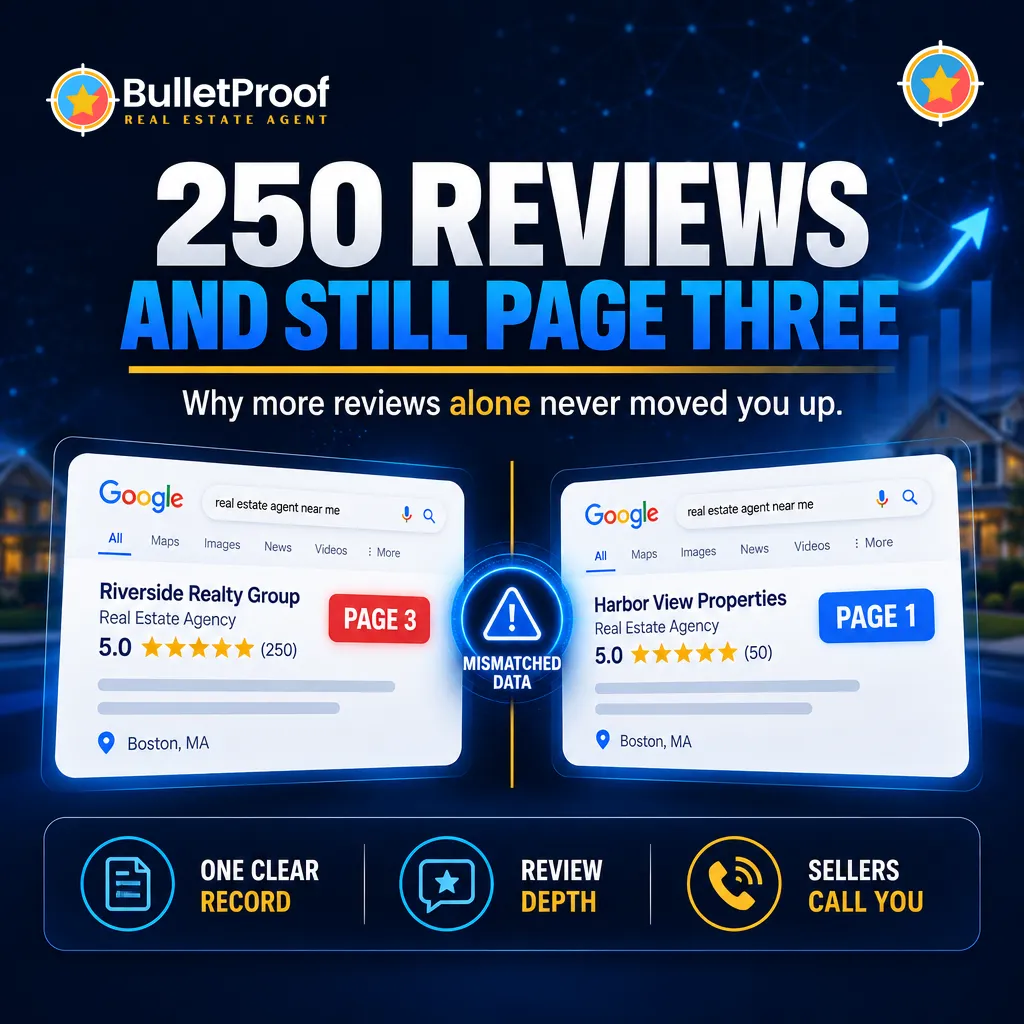
250 Reviews and Still on Page Three: Why More Reviews Didn't Rank You
You did the thing they told you to do. You asked. Every closing, every happy client, every "if you have a minute could you leave me a quick review." And the number climbed. Fifty. A hundred. Two hundred.
Then you searched your own market from your own phone, and there was somebody on page one with a fraction of your reviews and a fraction of your years. And you sat there for a second wondering what exactly you'd been collecting all that time. Am I close?
Machines don't recommend the best agent. They recommend the one they understand.
The agent with 250 reviews on page three
Ryan Comstock had been selling real estate for twenty years — Seattle, then Tucson. He had 250 Google reviews. Two hundred and fifty. And he was on page three, while agents with about fifty reviews were sitting on page one above him.
By every story we're told about reviews, that shouldn't be possible. He'd done the work. He'd earned the proof. It just wasn't counting.
When we went through his record, the cause had nothing to do with his reviews or his ability. His name, address and phone number didn't match across his profiles. Different suite formats. Different phone numbers. An old brokerage listing that never got updated. In his words: "I was confusing Google."
Once the record agreed with itself, the reviews he already had finally counted. Year one after the fix: 20 sales, roughly $250,000. By 2025 he was closing 24 deals a year from online alone — including buyers arriving from Copilot and Claude.
Same agent. Same reviews. Same twenty years. The only thing that changed was that a machine could finally understand who he was.
You are not the problem
This is the part worth sitting with, because most agents in this spot quietly decide they're bad at marketing.
You're not. You were sold pieces. A website from one vendor, a review tool from another, a profile a brokerage assistant set up years ago, a directory listing you never knew existed. Every piece was fine on its own. Nobody's job was to make the pieces agree — and agreement is the only thing the machine is checking.
Two wallpapered walls. One has plumbing behind it, one has studs and air. From the hallway, identical. Reviews are the faucet. If the pipe behind the wall doesn't connect, you can install the most beautiful faucet in Arizona and nothing comes out.
How the math actually works
Reviews matter. They're just not the whole equation, and they're not the first domino.
In local ranking, Google Business Profile signals account for roughly 32% and reviews roughly 20%. Meaning the profile itself — categories, service area, accurate name and phone, activity — carries more weight than the review pile sitting next to it. And about 74% of businesses get excluded from local results over name-address-phone mismatches. Excluded. Not ranked lower. Left out of the set the engine is even choosing from.
So the sequence isn't "collect reviews and hope." It's: make the record verifiable, then let the reviews do their job.
Depth beats count
Here's the second thing nobody tells you. An engine doesn't count your reviews the way a scoreboard does. It reads them.
"Great agent, highly recommend!" gives it nothing. There's no neighborhood, no problem, no outcome, nothing to quote to a seller asking a specific question. But "our house had sat for four months with another agent; she repriced it, restaged it, and we were under contract in nine days in Countryside" — that a machine can use. That's an answer, not a compliment.
Evan, in Palatine, Illinois, now ranks #1 for "Realtor" and "Realtor near me" in his market — ahead of a competitor with 392 reviews. Not by out-collecting him. By being clearer and more specific than him.
Tanya, in Miramar, Florida, crossed 101 Google reviews — more than the agent ranking #3 in her market — and moved to the top of page two after her Google Business Profile work. Her reviews had been accumulating the whole time. They started counting when the profile underneath them was right.
The loss you never hear about
It's a Tuesday. Somebody four streets from your last listing decides to sell. They type four words into their phone, read the two names that come back, and call one of them. By the weekend there's a sign in that yard.
Nobody weighed your twenty years and 250 reviews against that agent's four years and fifty. There was no contest. One record could be read and one couldn't. And you'll never know it happened, because nobody calls to tell you they picked someone else. That's the cruelty of this era, and also the opening — because it means the deciding factor is fixable.
What to do with the reviews you already have
- Audit for agreement first. Website, Google Business Profile, Zillow, Realtor.com, brokerage bio. Name, address, phone — character for character. Fix the disagreements before you ask for a single new review.
- Stop optimizing for the number. Start asking for specifics: which neighborhood, what was hard, what happened. One review like that outperforms ten of the generic kind.
- Keep the profile alive. Categories, service area, posts, photos, answered questions. It carries more ranking weight than the review count does.
- Answer questions publicly. Local, written, specific. The engine cites whoever answered.
- Then keep asking. About one review a week, forever. Steady beats bursts.
The honest part
None of this is fast. It's a six-to-twelve-month build, and the agents who quit at month four should never have started. If you want next-week results, this isn't it.
But notice what Ryan's story really says: the reviews weren't wasted. They were stored value waiting on a fix. If you've been collecting for years, you may be closer than the agent starting from zero — the golf pro's favorite student is the one who never swung wrong, but the second favorite is the one whose swing only needs one thing corrected.
Next spring, a seller in your market sits at her kitchen table, types four words, and reads what the machine says about you — or doesn't. Machines don't recommend the best agent. They recommend the one they understand. Later is not a decision.
Frequently asked questions
Why am I not ranking on Google if I have a lot of reviews?
Most often because your business data doesn't agree across sources. If your name, address and phone differ between your website, Google Business Profile and the major portals, Google can't confidently verify who you are — and roughly 74% of businesses get excluded from local results over exactly that mismatch, regardless of review count.
How many Google reviews does a real estate agent need to rank?
There's no threshold number. Reviews are about 20% of local ranking weight while Google Business Profile signals are about 32%. An agent with 50 specific reviews and a clean profile routinely outranks an agent with 250 generic ones.
Do detailed reviews really matter more than short ones?
Yes. Search and AI engines read review text for neighborhoods, problems and outcomes they can cite. A review naming the area and what was difficult about the sale is usable; "great agent" is not.
Will fixing my name, address and phone actually change my ranking?
It's usually the highest-leverage fix available. In one case an agent with 250 reviews moved off page three after his profiles were made consistent, and went on to close 20 sales in the following year from online visibility.
How long after a fix do results show up?
Data corrections can register within weeks, but meaningful ranking and AI-recommendation change is a six-to-twelve-month compounding process.
Related reading: The Listing You Never Knew You Lost