
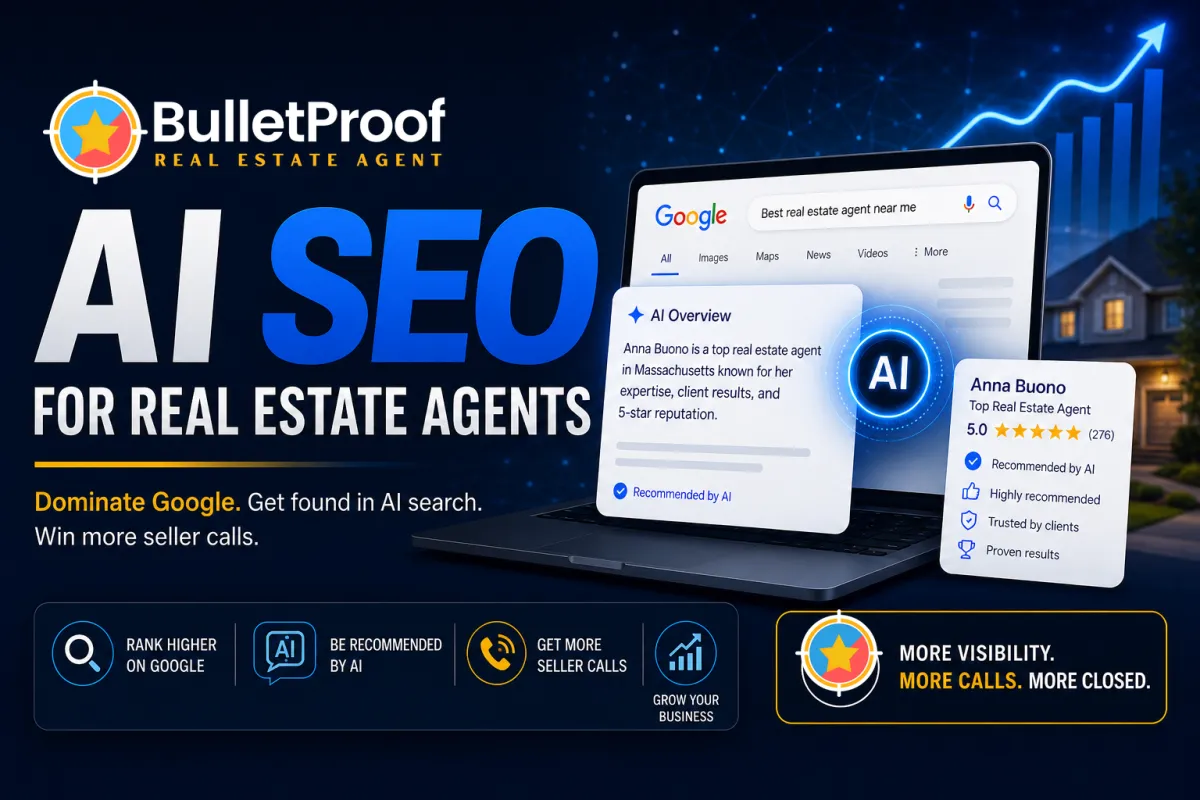
AI SEO for Real Estate Agents: What It Actually Is (2026)
Think about the last ninety days. You paid for the website. Maybe the SEO retainer too. The reports arrive every month with green arrows on them. And the phone still isn't ringing with sellers who found you on their own. Am I close?
Here's what changed while those reports were being generated. In May 2025, Google announced that AI-written answers would sit at the top of search — and they're staying there through 2026 and beyond. A seller doesn't scroll ten blue links anymore. She asks a question, and the machine answers with a name. One name. Sometimes two.
Machines don't recommend the best agent. They recommend the one they understand. AI SEO is simply the work of becoming that agent. That's the whole definition. Everything else in this article is just that one sentence taken seriously.
First, what AI SEO is not
It is not keywords stuffed into your homepage. It is not a prettier website. It is not posting three times a week on Instagram and hoping. And it is not whatever your current SEO report is measuring, if that report has been green for a year while your seller calls stayed flat.
If you've paid for some version of this and nothing moved, hear this before anything else: you are not the problem. You were sold pieces. The website company sold you pretty. The SEO company sold you a retainer measured in rankings nobody searches. Each piece may even have been fine. But pieces don't make a system, the same way two rooms of furniture don't make a house.
What the machines are actually doing
When a seller asks ChatGPT, Gemini, Perplexity or Google's AI "who's the best listing agent near me," the engine doesn't rank web pages. It builds a case. Like a careful clerk, it goes looking for an agent it can verify: does everything about this person agree — name, brokerage, phone, service area — everywhere it looks? Are the reviews specific enough to quote? Do other people — local press, directories, market reports — say the same things the agent says about herself? Has she answered, in writing, the questions this seller is actually asking?
If the answer is yes, the machine can understand her. So the machine recommends her. If the answer is no — if the record is thin, or worse, contradictory — the machine moves to the next name. It doesn't guess. Machines never guess. They skip.
And you never find out. That's the cruelest part of this whole shift. Nobody calls to tell you an AI passed over your name at 9:40 on a Tuesday night. The listing three streets over just quietly goes to someone else, and you file it under "slow market."
What AI SEO looks like when it's real
Evan Downey is a solo eXp agent in Dallas — a market with north of ten thousand agents. No team, no billboard budget. What he has is a record the machines can read: consistent details everywhere, reviews that tell stories instead of stacking stars, local content that answers real Dallas questions, proof documented where an engine can verify it. In 2025 he was named a best realtor in Dallas, and roughly $250,000 of his commission income arrived from Google, ChatGPT and Grok. Sellers he had never met, calling him.
Notice what that is. It isn't traffic. It isn't impressions. It's the machine, asked ten thousand times "who should I trust in Dallas," answering with the agent it understands.
The parts of real AI SEO, in plain English
Agreement. Your name, brokerage, phone and service area saying the exact same thing on your site, your Google Business Profile, Zillow, Realtor.com and every directory. Around 74% of businesses get excluded from local results over exactly this kind of mismatch. Boring work. Decisive work.
Quotable proof. Reviews that name the neighborhood, the problem and the outcome — the engines read them like a person would. "Great agent!" fifty times teaches the machine almost nothing.
Witnesses. Third-party mentions — local news, market reports, directories. The machine trusts what others say about you more than what you say about yourself. So would you.
Answers. Written, local, specific content for the questions your sellers actually type. The engine cites whoever answered the question. Not whoever deserved to.
A website that speaks machine. Structured data, clean signals, pages an engine can parse — plumbing, not wallpaper. A site can look expensive from the road and be studs and air behind the walls.
The honest part
This is a six-to-twelve-month build. Anyone promising you page one in thirty days is selling you the wallpaper again. And it isn't for everyone: an agent who would quit at month four should never start at all. But here's the thing the timeline hides — a low starting point is an advantage. The machine has no old bad information to unlearn about you. You get to hand it a clean, consistent record from day one, while agents with twenty years of scattered signals keep confusing it.
Because that's the quiet injustice of this era, and also its opportunity: nobody is weighing your twenty years against anyone's four. The machine weighs what it can read. Make yourself readable, and the experience finally counts.
Where to start this week
Ask ChatGPT and Gemini: "Who are the best real estate agents in [your market]?" Read what comes back. If your name is missing — or worse, wrong — you've just seen what every seller in your market sees. That's not a verdict on you. It's a to-do list.
Machines don't recommend the best agent. They recommend the one they understand. Next spring, a seller in your market will type four words into a box and read what the machine hands back. Whether your name is in that answer is being decided now — by the record you're building, or not building, this quarter. Sellers call you. That's the end state. The work starts with being understood.
FAQ
What is AI SEO for real estate agents?
AI SEO is the practice of making your professional record readable and verifiable to AI engines — ChatGPT, Gemini, Perplexity, Google AI — so they recommend you by name when sellers ask for an agent. It combines consistent business data, substantive reviews, third-party mentions, local content, and structured data on your website.
How is AI SEO different from traditional SEO?
Traditional SEO tries to rank a page in a list of links. AI SEO earns a recommendation in a direct answer. AI engines synthesize your reviews, citations and content into a judgment about you — so consistency and verifiable proof matter more than keywords.
How long does AI SEO take to work?
Expect six to twelve months of compounding work before AI engines reliably recommend you. Signals like review depth and third-party mentions build slowly — which is also why a head start is so hard for competitors to reverse.
Can a solo agent compete with big teams in AI results?
Yes. AI engines weigh clarity and proof, not headcount. Solo agents with consistent data and quotable reviews regularly outrank large teams — Evan Downey in Dallas, competing against 10,000+ agents, is one documented example.
Related reading: Zillow leads vs. owning your market: the $60,000 question.