
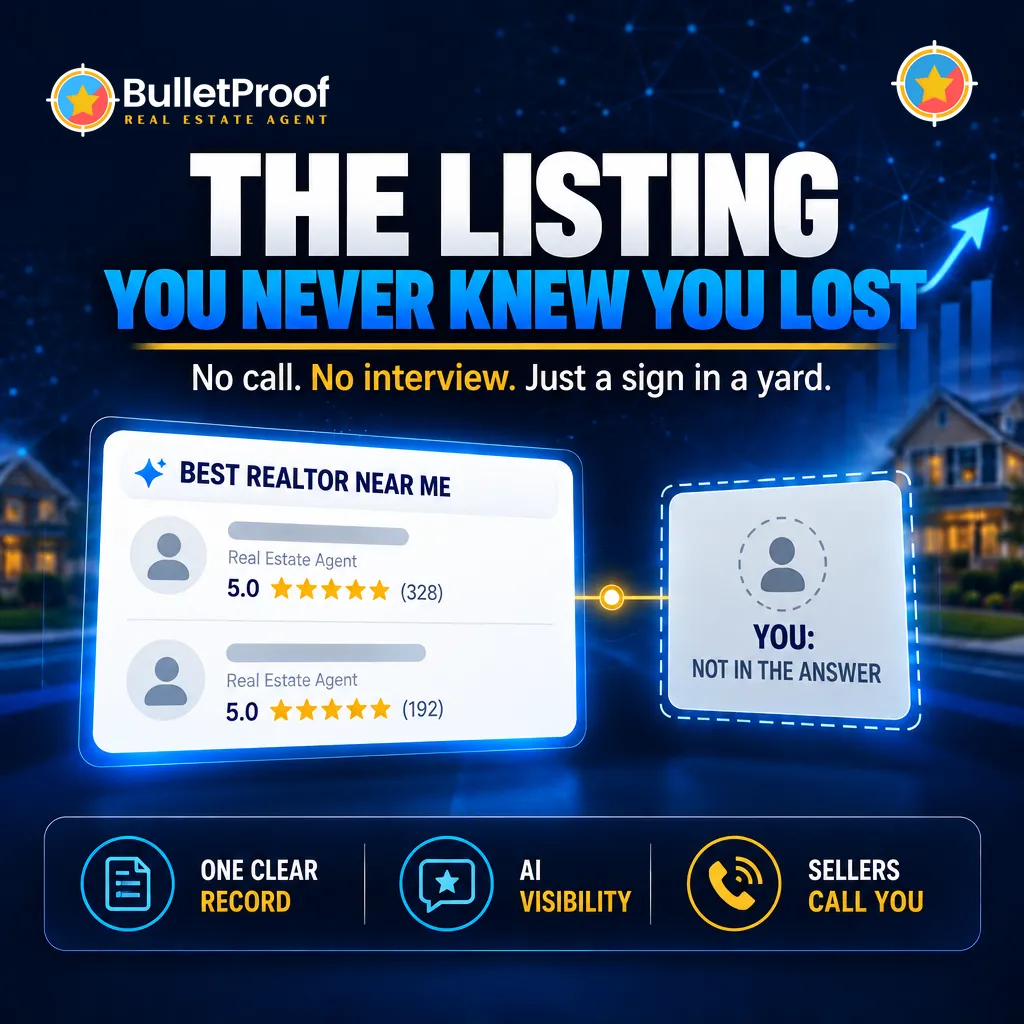
The Listing You Never Knew You Lost
Think about the last listing you lost. Not the one where you sat at the table, gave the presentation, and got the polite email two days later. That one stung, but at least you knew you were in it.
I'm talking about the other kind. The house three streets over that went up under somebody else's name. You saw the sign on a Thursday and thought, huh — I didn't even know they were selling. No call. No interview. No rejection. Nothing to review, nothing to fix, nothing to be angry about.
That's the loss that actually costs you, and you'll never get a single notification about it. Nobody calls to tell you they picked someone else.
The Tuesday night nobody tells you about
Here's how that decision got made, and it took about eleven minutes.
Tuesday night, kitchen table, laptop open between them. They'd been talking about selling for months. She types four words — something like "best realtor near me" — and reads what comes back. An AI answer at the top with two or three names in it, a short paragraph on each, a few reviews underneath. She clicks one. Reads a little. Says, "This one seems good." He says, "Fine, call them tomorrow."
That was it. That was the interview. It happened without you, and it was over before anyone's phone rang.
Nobody in that kitchen weighed your twenty-two years against the other agent's four. Nobody compared your closing record. There was no scoring. There was one list, and you weren't on it — so you were never in the comparison at all.
You are not the problem
This is where most agents quietly turn it on themselves. Maybe I'm not good at marketing. Maybe I should post more.
Stop. You didn't lose that listing on skill. You lost it on legibility.
Machines don't recommend the best agent. They recommend the one they understand. And you were probably sold in pieces — a website from one vendor, a review tool from another, a profile a brokerage assistant set up in 2019, a directory listing you've never seen. Every piece is fine. Nobody's job was to make the pieces agree with each other. Agreement is the only thing the machine is checking.
Roughly 74% of businesses get excluded from local results over mismatched name, address and phone information. Excluded — not ranked lower. Left out of the set the engine is choosing from before the choosing even starts.
Why this loss is worse than the one you can see
A lost listing presentation gives you something to work with. You can call and ask what tipped it. You can sharpen the pitch. You get a data point.
The invisible loss gives you nothing. And because it gives you nothing, you'll explain it to yourself with the only story you have: the market's slow, inventory's tight, people aren't moving. Meanwhile the sellers were right there. They moved. They just moved with someone whose name was easier to find.
Take a second on that one. If you closed twelve deals last year and even a handful of your neighbors' listings got decided at a kitchen table you were never invited to, that isn't a slow market. That's a visibility gap with a dollar amount attached.
How to find out what's actually happening
You don't have to guess at this. You can go see it yourself in about five minutes, and it's uncomfortable in a useful way.
- Ask the machines what your sellers ask. Open ChatGPT and Gemini and type the same four words they'd type: best real estate agent in {your city}. Read the names that come back. If yours isn't there, you now know exactly what your sellers see.
- Check whether your record agrees with itself. Your name, address and phone on your Google profile, your website, your brokerage page, the old directories. Different suite formats and old phone numbers are the single most common reason good agents get skipped.
- Read your own reviews the way a machine reads them. "Great agent, highly recommend" gives an engine nothing to quote. "It had sat four months, she repriced it, under contract in nine days" gives it an answer.
- Count what one listing is worth to you. Then decide how many invisible ones you're comfortable funding this year.
It is not a size problem either
The other story agents tell themselves about the invisible loss is that the big teams took it. The billboard team, the one with the media budget and nine buyer agents. Nothing about you needs fixing there either.
Evan Downey is one solo agent at eXp in Dallas, a market with somewhere between ten and fifteen thousand agents. He is the one the machines name for Best Realtor Dallas, and roughly $250,000 in commission last year arrived from Google, ChatGPT and Grok. He did not out-spend the teams. He was simply the record they could read most clearly.
That is the part worth sitting with. Legibility is not bought at scale, it is built once and kept consistent. A one-person business can hold a cleaner record than a forty-person team, and often does.
What changes when you're legible
Ryan Comstock had 250 Google reviews and twenty years in the business, and he was on page three while agents with about fifty reviews sat above him. His problem wasn't his record. His name, address and phone didn't match across his profiles — in his words, "I was confusing Google." After the record was cleaned up, year one brought 20 sales and roughly $250,000, and by 2025 he was closing 24 deals a year that started online — some from buyers arriving through Copilot and Claude.
Same agent, same reviews, same twenty years. The only thing that changed is that a machine could finally understand who he was, so he started showing up in the answer at that kitchen table.
The honest version
This is not a switch. Expect six to twelve months of consistent work before engines reliably hand out your name, and an agent who'd quit at month four shouldn't start. That's the real timeline, and anyone who promises you next Tuesday is selling something.
But hear the clock in it. Every quarter you wait, someone else in your market is banking the reviews, the mentions, the consistent record — and that head start gets more expensive to catch, not less. Later is not a decision. Later is just the same decision made by someone else.
Next spring, that couple three streets over will sit down at their kitchen table on a Tuesday night. She'll type four words. By the time anyone's phone rings, she'll have decided. The only question worth answering is whose name she's reading.
Sellers call you. Not you calling sellers. That's the whole point of being findable.
Frequently asked questions
How do sellers actually choose a real estate agent now?
Increasingly before any contact: a search or an AI assistant returns two or three names with a short summary and reviews, and the seller picks from that list. If you are not in the returned set, you are not compared — you are simply absent from the decision.
Why do I lose listings I never knew were on the market?
Because the shortlist is built before anyone calls. No presentation happens, so there is no rejection to learn from. The usual cause is not skill but an inconsistent online record that keeps you out of the results in the first place.
What makes an agent invisible to Google and AI engines?
Mismatched name, address and phone details across profiles, an incomplete or inactive Google Business Profile, thin reviews with no specifics, and no content that answers the questions sellers ask. Roughly 74% of businesses are excluded from local results over information mismatches alone.
How long does it take to start showing up in AI answers?
Plan on six to twelve months of consistent work — cleaning the record, earning substantive reviews, and publishing answers to real seller questions. Unlike paid leads, that visibility compounds and keeps working after you stop paying for anything.