
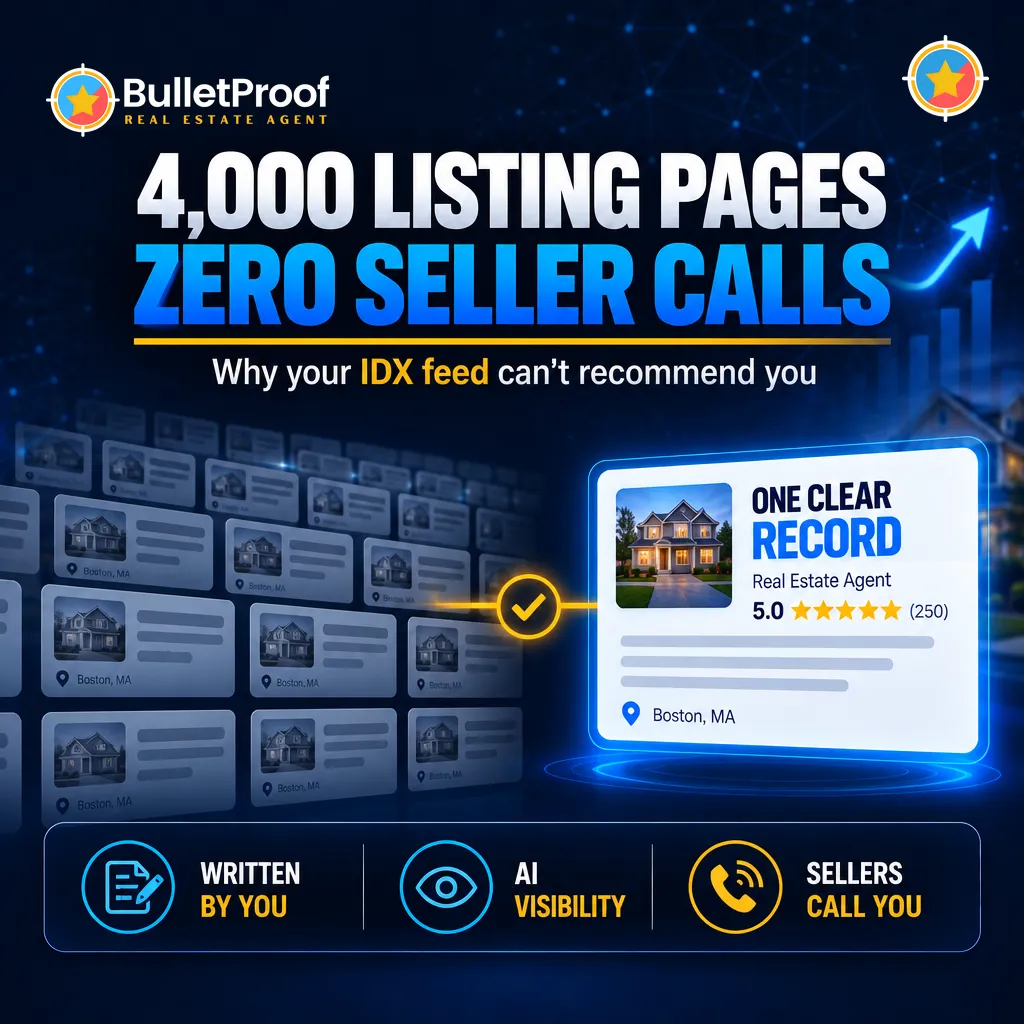
Your Website vs. Your MLS Feed: Why IDX Pages Don't Get You Recommended
You bought the website you were told to buy. It has search. It has maps. It has every active listing in your market, updating itself three times a day. Somebody told you it was thousands of pages of content, and it sounded like an advantage. So when the calls didn't come, you assumed the site was fine and the problem was traffic. Am I close?
Here's the part nobody explains at the sales stage. Those thousands of pages are not yours. They're the same pages on the site of every other agent in your market who bought a feed from the same place. Same photos. Same remarks. Same square footage, written by the listing agent, not by you.
Machines don't recommend the best agent. They recommend the one they understand.
And there is nothing about a duplicated listing feed that helps a machine understand you.
You are not the problem
Before anything else: if you have an IDX site and it hasn't produced a single seller call in a year, that is not a sign you're bad at this.
You were sold a product that answers a different question than the one your sellers ask. An IDX feed answers "what's for sale?" Your seller is asking "who should I trust to sell mine?" Those are two different businesses. The feed was built for the first one, and it was handed to you as if it solved the second.
Two walls, both wallpapered beautifully. One has plumbing behind it, one has studs and air. A big IDX site is a lot of wallpaper. It looks like substance from the hallway. Turn on the tap — ask an engine who the best listing agent in your town is — and you find out whether anything is connected.
What a duplicated page proves about you: nothing
Put yourself in the position of the machine for a second. It is trying to decide which two or three names to put in a one-sentence answer. It needs something specific it can point at.
- A listing detail page tells it about a house. Not about you. Remove your header and it could belong to anybody.
- The same page exists in near-identical form on dozens of other sites, so it carries no distinguishing signal. Sameness is proof of identity for your name, address and phone — and the opposite for your content.
- The page usually disappears when the home sells, which means whatever weak signal it had leaves with it.
- None of it is written by you, so none of it demonstrates that you know your market.
Compare that to one page you wrote about what a specific neighborhood sold for last quarter and why the ones that sat too long sat too long. That page has an author. It has an opinion. It can be quoted.
The engine cites whoever answered the question. Usually not the person with the biggest feed.
The two jobs your website actually has
Job one is proof of identity. Your name, your brokerage, your phone number, your service area — stated the same way here as on your Google Business Profile and every directory that ever scraped you. That's plumbing work, and it is not optional.
Ryan Comstock had twenty years and 250 Google reviews and sat on page three while fifty-review agents sat on page one. The cause was not his reviews and not his site design. His name, address and phone number disagreed with each other across his profiles. His words: "I was confusing Google." After the record was made to agree, year one produced 20 sales and about $250,000, and by 2025 he was closing 24 deals a year from online — with buyers arriving through Copilot and Claude.
Job two is answers. A handful of pages, written by you, about the questions sellers in your market actually type. Not a blog for the sake of a blog. Ten to twenty real answers beat ten thousand borrowed listing pages, every time.
Two agents, same market
Agent A has 4,000 IDX pages and a homepage that says "Your Trusted Local Expert." Agent B has 30 pages: one clear identity, one page per neighborhood she actually works, reviews that name streets and problems, and answers to the six questions sellers ask her on every listing appointment.
Ask an engine who to call. It has nothing to say about Agent A except that she has a lot of houses on her website, which every competitor also has. About Agent B it can say a sentence with reasons in it. That's the whole contest.
Evan Downey is a solo eXp agent in Dallas — a market with somewhere between ten and fifteen thousand agents. He didn't out-build anyone's feed. He ended up ranked for Best Realtor Dallas in 2025 and roughly $250,000 in commission arriving from Google, ChatGPT and Grok, because his record was legible and his answers were his own.
The invisible loss
It's a Tuesday. A couple three streets from a listing you'd have loved decides to sell. They type four words into their phone, read the two names that come back, and call the second one. By Thursday there's a sign in the yard, and it isn't yours.
Your 4,000 listing pages were live that whole morning. Nobody weighed your twenty-two years against that agent's four, because there was no contest to weigh. One record could be read and one couldn't. And you never even knew you lost it, because nobody calls to tell you they picked someone else.
What to do this week, in about an hour
- Ask ChatGPT and Gemini: "Who are the best real estate agents in [your market]?" Write down whether your name appears and what the answer says about you.
- Open your site's contact page, your Google Business Profile, Zillow and Realtor.com side by side. Compare name, address and phone character by character. Fix every disagreement.
- Count how many pages on your website were written by you about your market. If the answer is under five, you now know the real gap.
- Write one — the honest answer to the question you get asked at every listing appointment. Local, specific, in your own words.
- Keep the feed. It's useful for buyers and it costs you nothing to leave running. Just stop expecting it to introduce you.
The honest part
This is a six-to-twelve-month build. Content authority compounds by quarters, not by weeks, and anyone promising page one by next month is selling wallpaper again. Agents who quit at month four should never have started — the compounding is the entire mechanism.
And it runs whether you start it or not. Somebody in your market started eighteen months ago, and that head start is theirs until you build one of your own. Later is not a decision.
Next spring, a seller two streets over sits at her kitchen table, types four words, and reads what the machine says about you. It will not be reading your listing feed. It will be reading your record. Machines don't recommend the best agent. They recommend the one they understand.
Frequently asked questions
Do IDX listing pages help my SEO at all?
Marginally, and mostly for buyer searches on individual addresses. Because the same feed content appears on many agent sites, those pages rarely rank and they say nothing about you as an agent, so they do little for seller-intent searches or AI recommendations.
Should I remove IDX from my website?
No. Keep it for buyers who want to search homes. Just stop counting it as content and add a small set of pages you write yourself about your market, your process and your results.
How many pages do I actually need?
Fewer than you were sold. A consistent identity, one page per neighborhood you genuinely work, and answers to the questions your sellers ask — usually ten to thirty pages — outperform thousands of duplicated listing pages.
Why do AI engines ignore my listing pages?
Because they are duplicated across many sites, they are written by listing agents rather than by you, and they disappear when the home sells. An engine needs something specific and durable it can attribute to you before it will use your name in an answer.
What matters more, my website or my Google Business Profile?
They work as one record. Local ranking weight sits heavily with Google Business Profile signals, but the profile is only trusted when your website says the same thing. Make them agree first, then add your own content.
Want to know what the engines currently say when someone asks for the best agent in your market? Start with a free AI visibility audit, then book a walkthrough if you want help fixing what it finds.
Related reading: How AI builds the "top real estate agent in your city" shortlist