Should Real Estate Agents Buy a Website for Every Town? Microsites vs One Strong Site
It starts with a good idea at the kitchen table. You serve five towns. So you buy five domain names, one for each town, with the town right there in the address. It feels smart. It feels like covering your whole market.
A year later, three of those sites have a handful of visitors. One has a broken contact form. And you're paying renewal fees on all of them. Am I close?
You weren't wrong to want every town to find you. That instinct is exactly right. The setup just works against it.
The short answer
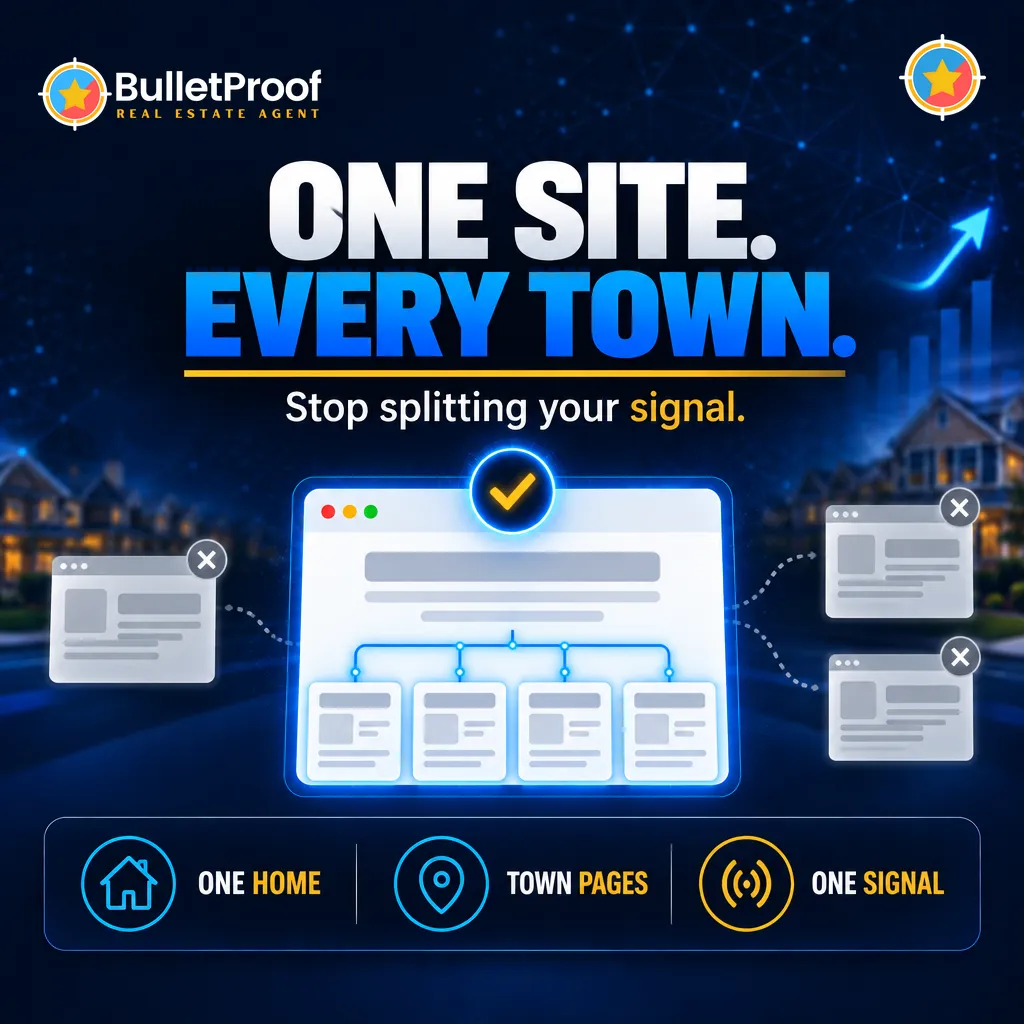
For most agents, no. Separate small websites for each town rarely help you rank on Google or show up in AI answers anymore. One strong website, tied to your Google Business Profile, with a real page for every town you serve, almost always does more. There are a few honest exceptions, and we'll cover them below.
AI doesn't pick the best agent. It picks the agent it can understand. Five thin websites give Google and AI five half-stories about you. One strong site gives them the whole one.
Why splitting your website splits your signal
Every review, every link, every mention and every page you publish builds trust in one place. When you spread that across five domains, each site gets a fraction. None of them gets enough to stand out.
Think of it like a well. One deep well reaches water. Five shallow holes across the yard just leave you with five puddles and a lot of digging.
Video transcript: Nobody is telling realtors this right now. If your website is not built for AI, you are already behind, and most agents don't even see it. Because Google and ChatGPT are starting to influence who gets recommended, and they don't care how your website looks. They care about structure, authority, and content they can actually understand. Most agent websites don't have that, which means when someone asks, "Who should I list my home with?", they don't even get considered. That's the gap right now. Want to fix your broken website and start generating come-list-me calls off of Google and ChatGPT? Follow for more content like this, and I'll see you at the top.
AI tools make this even more true. When a seller asks ChatGPT, Gemini, Claude, Perplexity, Copilot or another AI tool who to call, the answer is built from what the tool can find and trust about you. A tiny site with three pages and no reviews of its own is easy to skip. A deep site with your story, your towns and your track record is easy to quote.
Ask yourself one small question. When was the last time you updated all five of those sites? If the honest answer is never, a machine can tell. Stale pages look like an agent who moved on.
There is a second problem, and it is quieter. Each new site is another place your name, phone number and details can drift out of sync. Ryan Comstock spent 20 years in the business and sat on page three with 250 reviews, while agents with about 50 sat on page one. The cause wasn't his skill. It was mismatched contact details across the web. In his words, "I was confusing Google." Extra sites with slightly different details create exactly that kind of confusion.
And a confused machine doesn't send you a warning. It just names someone else. Nobody calls to tell you they picked someone else.
What works instead: one site, a page for every town
You still want every town to find you. You just build it inside one home.
One website on a domain you own
Your name, your story, your market, in one place every engine can read and every seller can trust.
A real page for each town and neighborhood
Not a copy-and-paste page with the town name swapped. A page that answers what sellers in that town actually ask. We wrote a full guide to the neighborhood page you do not have, and another on whether to go deep in one town or cover the whole metro.
Pages linked to each other
Town pages, neighborhood pages, your blog and your reviews should point to each other, so a machine can see the whole picture of where you work.
A Google profile and contact details that match
The same name, phone number and address on your site, your Google profile and everywhere else. That is the fix that moved Ryan, and it is why mismatched contact details matter so much.
What happens when it's all in one place
Our clients don't describe a pile of sites. They describe one site that started working.
Kim sells in Cincinnati, Ohio. Talking with our team in September, she said: "End of July, in one week, I had three people that called and found me through my website and said, come list me."
Kurt sells in Grass Valley and Nevada City, California. He described something he had never seen before: "Now we're getting people actually using our website... and requesting home evaluations. Which isn't something that we've ever seen before. And not just with Bulletproof, but ever."
Irina, in Joliet, Illinois, put it simply: "When people hire me, they're like, I love your website. And I have never heard that before."
Three markets. Three agents whose own website became the place sellers found them. That is what one clear story, in one place, can do. You can find more stories like these in our case studies.
What we tell our clients about extra domains
Here is our own view, the same thing we tell agents who ask about buying a domain for every town. Build one strong site first.
- For organic search and AI answers, small separate domains generally don't work anymore. One authority website tied to your Google profile wins.
- Paid ads don't need separate domains either. A community landing page with a simple way to reach you does the job.
- The honest exception: a site built around one condo building, gated community or development can work, both in search and with ads.
- Truly working a second market is a second location: its own office, its own Google profile and its own site, built on the same blueprint. Some of our clients run two or three locations this way.
- Before buying more domains, check what a strong Google profile can already reach. It often pulls business from nearby towns on its own.
Who this is for, and who it isn't
This is for agents who serve several towns and want every one of them to find them, without running five websites. It isn't for agents with a real second office in another market. That is a different setup, and it deserves its own site and profile.
If you already own a few town domains, you don't have to throw them away overnight. The usual move is to build the real town pages on your main site first, then point the old domains at them, so nothing you already earned goes to waste. Whoever manages your website can set up those redirects for you.
It also takes time. Six to twelve months to full strength is the honest number. A BulletProof website is built to hold every town you serve in one place. Want to see what Google and AI tools say about you right now? Get a free AI visibility audit.
The bottom line
More websites feel like more reach. For most agents, they are more upkeep and a thinner signal. Later is not a decision, though. Every month your trust is split five ways is a month the agent with one strong site keeps adding to theirs.
AI doesn't pick the best agent. It picks the agent it can understand. Picture next spring. A seller in the smallest town you serve asks who to call. The answer pulls your town page, your reviews and your story from one place, and by the time your phone rings, she has already decided. Sellers call you. Not you calling sellers.
Frequently asked questions
Should a real estate agent have a separate website for each city?
Usually not. Separate small domains rarely help with organic search or AI answers anymore. One strong website with a real page for each town, tied to your Google Business Profile, almost always performs better.
Do exact-match domain names help real estate agents rank?
Not on their own. A town name in the domain doesn't make up for a thin site. Pages that answer local questions, matching contact details and steady reviews do far more.
When does a separate real estate website make sense?
A site about one condo building, gated community or development can work. So can a true second location with its own office and Google profile. For ads, a landing page on your main site is usually enough.
Will multiple websites confuse Google and AI tools?
They can. Each extra site is another place your name, phone number and details can drift out of sync, and mismatched details make it harder for Google and AI to be sure who you are.
How do I show up in several towns with one website?
Build a real page for each town and key neighborhood, link those pages to each other and to your blog, keep your Google profile and contact details matched everywhere, and keep collecting reviews.