What Makes a Real Estate Website Machine-Readable? A Plain-English Guide for Agents
You paid for a beautiful website. Big photos. Clean fonts. Your best listing on the home page. Friends tell you it looks great.
But when a seller asks Google or ChatGPT who the best agent in your town is, your name doesn't come back. The site looks finished. The phone doesn't ring. Am I close?
Nothing about you or your taste is the problem. The issue is who else is looking at your site. It isn't only sellers anymore. It's machines.
The short answer
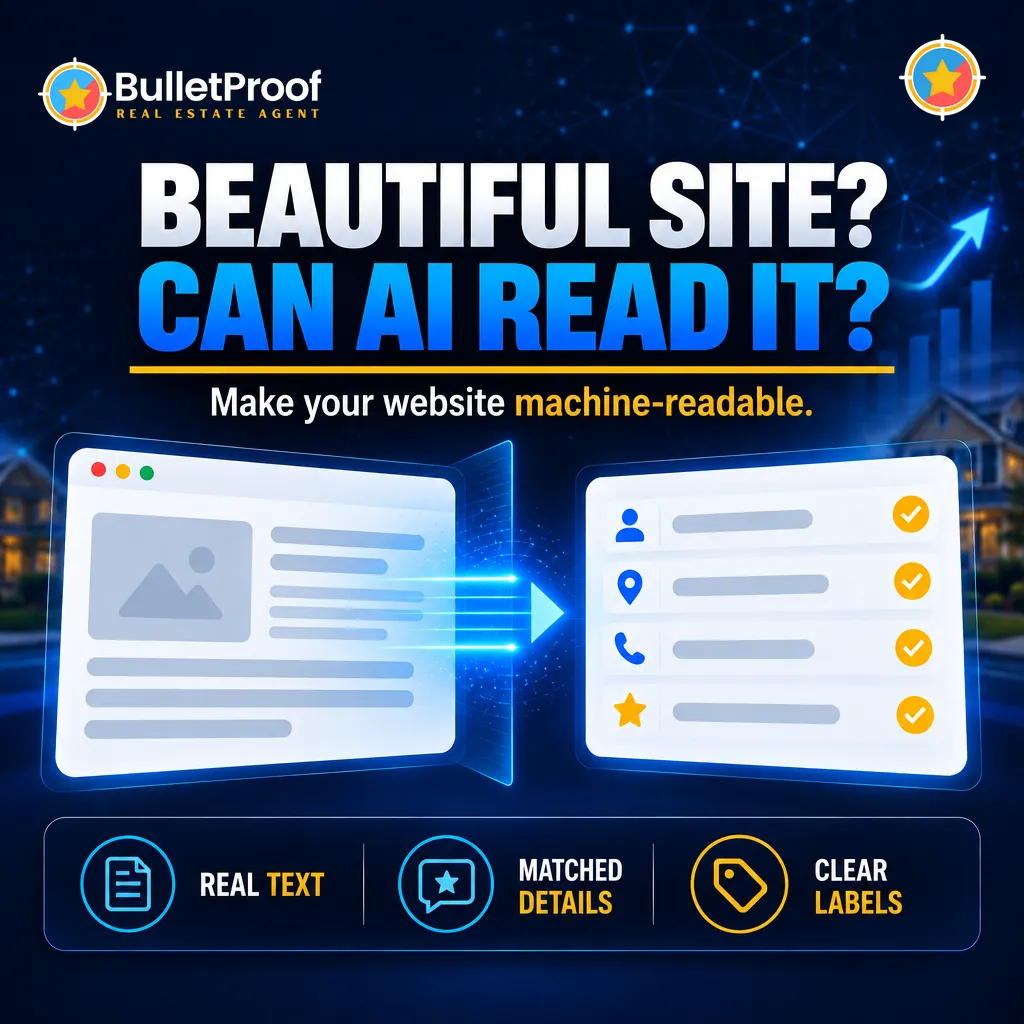
A machine-readable website is one that Google and AI tools can read and understand without guessing. Your name, your business, the towns you serve, what you do and why people trust you are all spelled out in plain words and clear labels. A site can be gorgeous to a person and nearly blank to a machine.
AI doesn't pick the best agent. It picks the agent it can understand. Your website is the one place online where you control every word a machine reads about you.
How a machine reads your website
Picture your website as a house. A seller walks up the driveway and sees the paint, the porch and the flowers. A machine walks in the back door and reads the wiring.
Video transcript: I wasn't planning on bringing this up, but your website might actually be costing you listings. And I don't mean it looks bad. I mean, it's not showing up on Google, and it's not being picked up by AI like ChatGPT. So when a seller searches Realtor in your city, or asks who they should hire, you're not even in the conversation. That listing, it goes to the agent who is. Most agents think their website is an asset, but if it's not built for visibility and authority, it's a liability. Visibility gets the click. Authority gets you recommended. Trust gets the "come list me" call. If your website isn't working for Google and AI, it's working against you. Follow for more ways to make sure sellers call you.
It reads at machine speed. It doesn't admire the photo of you on the porch, and it doesn't call to ask what you meant. It takes what is written and labeled, and it moves on. If your towns only appear inside a photo, your awards only sit in a logo graphic and your phone number lives in a picture, the machine may never connect them to you.
Google says this in its own words. Its guide to structured data opens with: "Google Search works hard to understand the content of a page. You can help us by providing explicit clues about the meaning of a page to Google by including structured data on the page." You can read it on Google's own introduction to structured data. Structured data is simply a set of labels in the code that say this is a person, this is a business, this is the area it serves.
AI tools work from the same raw material. When a seller asks ChatGPT, Gemini, Claude, Perplexity, Copilot or another AI tool who to call, the answer is built from what those tools can find, read and trust about you.
The cost you never see
Here is what makes this painful. A site that machines can't read doesn't throw an error. It just loses quietly.
The seller three streets over asks her phone who knows her neighborhood. The answer names an agent whose site says, in plain words, which towns she serves, how long she's sold there and what her clients say. Your site says it too, but inside a photo. Nobody calls to tell you they picked someone else.
Ryan Comstock learned a version of this the hard way. Twenty years in, 250 reviews, and stuck on page three while agents with about 50 sat on page one. The cause was mismatched contact details across the web. In his words, "I was confusing Google." A machine that isn't sure who you are will name someone it is sure about. That is why mismatched contact details matter so much.
What machine-readable looks like on an agent's site
You don't need to learn code. You need to know what to look for.
Your basics in plain text
Your name, brokerage, phone number and the towns you serve, written as real text on the page, not only inside a logo or image. Try to highlight them with your mouse. If you can't select the words, a machine may not read them either.
One clear page for each thing you do
A page for selling, a page for each town, a page about you. Pages built only from an MLS feed rarely say anything new, which is why IDX pages alone don't get you recommended.
Labels in the code
Structured data that tells search engines you are a real estate agent, the business you work under and the area you serve. Your visitors never see it. Machines read it first.
Answers in your own words
The questions sellers actually ask, answered on the page. A FAQ page written in your own words is one of the simplest ways to hand a machine an answer it can quote.
What sellers say when the site does its job
When a site is clear to machines, it tends to be clear to people too. Our clients hear it from the sellers and buyers who call.
Pattie sells in southern Maine, around the Sebago Lake region. She told our team about buyers who came to her instead of the listing broker: "They said, but we checked out your reviews and your web page and everything. And they said, we just want to work with you." Moments later she added: "So my webpage, they looked at it, looked at the reviews, and they said, she's quality."
Matt sells in Whittier, California. Talking with an agent who was considering us, he put it plainly: "they build the website out, work with my SEO. They're even, you know, help coach me on how to get reviews."
Tony and Pam sell in the Atlanta area. On a call this summer, Tony mentioned something visitors noticed right away: "I've had good, good comments about our search bar now... we changed over to where it's like an AI type of search bar... People like that."
None of those comments are about fonts. They are about a site that answered the question someone came with.
What we tell our clients about a machine-readable website
Here is our own view, the same thing our team says on client calls. Your site may look great from the road. AI reads what's behind the wall.
- Put your name, brokerage, phone and towns in real text on every key page, not only in images.
- Keep the same name, address and phone on your site, your Google profile and everywhere else. We keep those details matched across more than 50 online profiles for our clients, because one mismatch is enough to confuse a machine.
- Write your bio heavy with real accolades, years and towns, in text a machine can quote, not a list of adjectives.
- Ask whoever runs your website one question: does the site have structured data that names me as an agent and the area I serve? Then check a page with Google's free Rich Results Test.
- When you add a video, put the words on the page too. A machine can read a transcript far more reliably than it can watch you talk.
Who this is for, and who it isn't
This is for agents who already have a site they like and want it to start pulling its weight. Most of these fixes sit on top of the design you have. If you're wondering whether your site's job has changed, the short version is that it hasn't gone away. It has picked up a second reader.
It isn't a one-week fix that makes the phone ring by Friday. Six to twelve months to full strength is the honest timeline. A BulletProof website is built to be read by people and machines alike. Want to see how Google and AI tools describe you right now? Get a free AI visibility audit.
The bottom line
A website has two readers now. One admires the photos. The other reads the wiring at machine speed and decides whether to say your name.
AI doesn't pick the best agent. It picks the agent it can understand. Picture next spring. A seller asks who sells the most homes on her side of town. The answer pulls your town page, your bio and your reviews, all in plain words, and by the time your phone rings, she has already decided. Sellers call you. Not you calling sellers.
Frequently asked questions
What does machine-readable mean for a real estate website?
It means Google and AI tools can read and understand your site without guessing: your name, business, towns served, services and reviews are written in plain text and labeled clearly, not hidden inside images or graphics.
Do real estate agents need structured data on their website?
It helps. Google says structured data gives it explicit clues about the meaning of a page. For an agent, that means labeling you as a real estate agent, your business and your service area.
Can a beautiful website still be invisible to AI?
Yes. A site can look polished to people while its key facts sit inside photos, logos or scripts a machine can't read reliably. Design and machine-readability work together; one doesn't replace the other.
How can I check if my website is machine-readable?
Try selecting your name, phone and towns with your mouse to confirm they are real text, run a page through Google's free Rich Results Test, and ask an AI tool what it knows about you and your market.
How long until a machine-readable site shows up in AI answers?
Plan on six to twelve months to full strength. The site works alongside your Google profile, reviews and matching details across the web.
Related reading: Can Google and AI read your real estate videos?