One Town or the Whole Metro? Why Hyperlocal Real Estate Agents Get Found First
Most agents market like this: "Serving the greater metro area and all surrounding communities."
It feels safe. It feels big. Why would you shrink your market on purpose?
Because nobody searches for "the greater metro area." They search for a town. A neighborhood. A school district. A street they drove down last weekend and fell in love with. And when Google, ChatGPT, Gemini or Claude has to pick one agent for that exact place, it does not pick the agent who claims everything. It picks the one it can clearly connect to that place.
AI doesn't pick the best agent. It picks the agent it can understand.
Wide feels safe. Wide is invisible.
Think about how you would describe yourself to a stranger at a party. If you say, "I sell homes everywhere," they forget you before the next drink. If you say, "I'm the agent for Wellington," they remember. And the next time someone mentions Wellington, they think of you.
Search engines and AI tools work the same way. They build a picture of you from your website, your Google profile, your reviews, press mentions and anything else they can find. If that picture says "everywhere," it is blurry. If it says one town again and again, with real detail, it is sharp.
A blurry picture loses to a sharp one. Every time. Even when the blurry agent has more experience. That is the Big Idea in one line: AI doesn't pick the best agent. It picks the agent it can understand.
Video transcript: Think about the last time you hired a plumber. Did you call the best one in town or the one that came up first when you searched? Your sellers are doing the same thing right now This happens to successful agents every single time. Full-time, three years or more, and at least 12 to 15 deals a year. Agents who have already paid someone to fix this. Put two walls in front of you. Same paint, same finish, same price. Standing in that room, you cannot tell them apart. Now, take a hammer to both of them. Behind the first one, you've got just studs and air. Behind the second one, pipes, wires, everything that makes a house work. Could you have told the difference before the hammer? No, and neither could the person who sold it to you. That's your website. It looks perfect from the road, but the part that tells Google and AI who you are was never built. The page comes back blank to the machine. Same with the SEO company you paid every single month. Somebody sold you one piece, but the machine is checking whether everything about you agrees. You cannot buy agreement one line item at a time. So the money did not fail because of you. It failed because everyone was working on the wallpaper. Machines don't recommend the best agent. They recommend the one they understand.
Brent and Raquel, Wellington, Florida: pinpointed, not wide
Brent and Raquel work in Wellington, Florida, a community with its own identity next to a much bigger metro. Instead of trying to cover all of it, their plan went deep on one place: pages and blogs about the smaller communities inside Wellington, landing pages built around the town, and a press release.
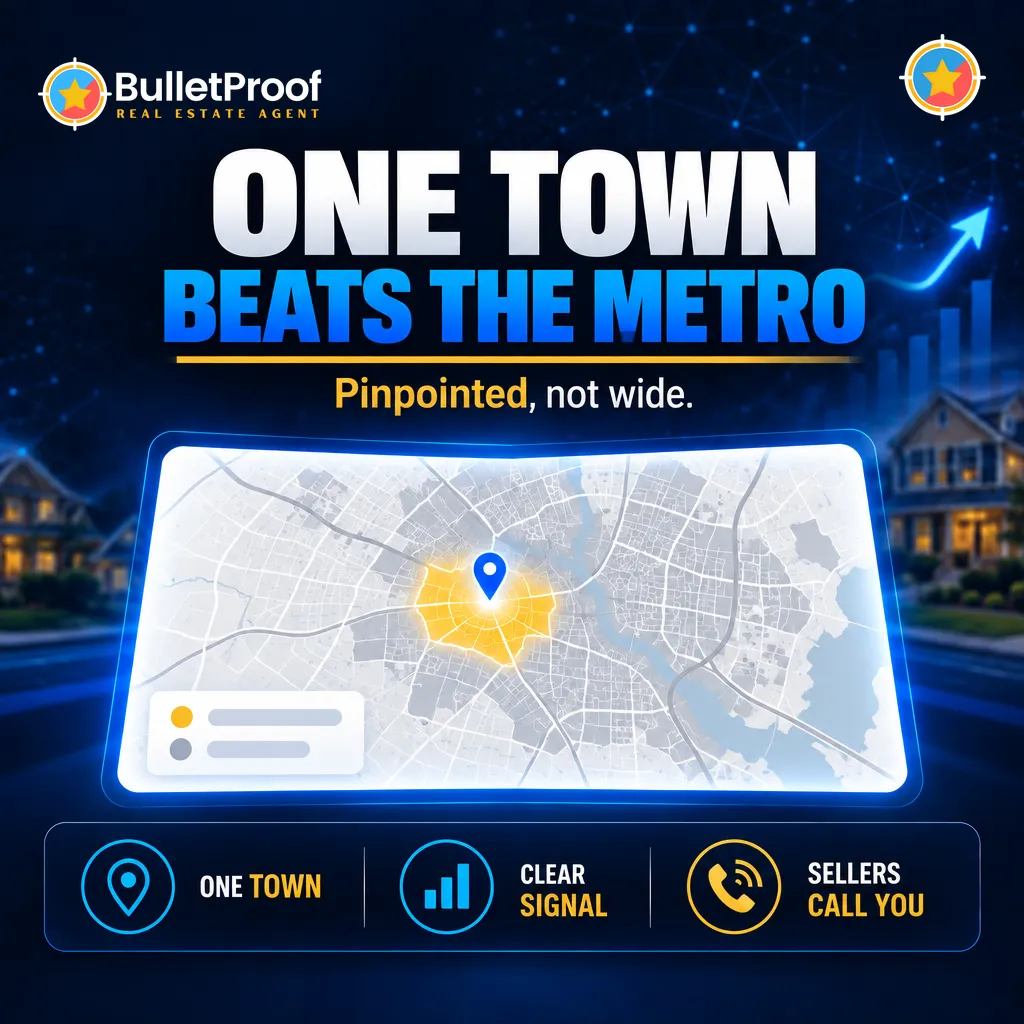
On a September call, Brent summed up why it was working in his own words: "I mean, just drilling down in Wellington... It's helping, too, because we're pinpointed versus trying to be wide."
Pinpointed versus wide. That is the whole strategy in four words.
And other agents noticed. Brent mentioned that local agents had been poking around their site. His take: "They probably saw their ranking and wanted to see how it worked." When your competitors start studying your website, you know the focus is showing up.
What hyperlocal actually looks like
Going hyperlocal is not about putting a town name in your footer. It is about becoming the most useful, most consistent source about one place. Here is what that means in practice:
- One primary town or area named the same way on your website, your Google profile and your social bios.
- A page for each neighborhood or community inside that area, written like a local, not a brochure.
- Blogs that answer the questions people in that town actually ask, from schools to commute times to what homes sold for last season.
- Reviews that mention the town, so every new review repeats the signal.
- Press and local mentions that tie your name to that place.
We have written before about why a real neighborhood page beats a generic city page. The short version: a page that only a local could write is a page a machine trusts. You can see how that plays out between two agents in the same town in why AI picks one agent over another in the same city.
Lisa, Fort Myers and Naples, Florida: local numbers only a local has
Here is the kind of detail that makes an agent the obvious local expert. Lisa works the Fort Myers and Naples market. On a September call, she walked through her own listing numbers like someone who lives inside that market every day.
"We are now selling at 36 days on market versus 90 something days on market."
Those are her results with her own listings, not something we did for her. But look at what that sentence is. It is a specific, local, comparison-based fact. That is exactly the kind of content that belongs on a hyperlocal page or blog, because no national website can write it. A family moving to Naples wants to know how fast homes sell there and who actually knows. Lisa can answer that in one line.
When she talked about working with our team, she kept it simple: "Like I really haven't had to do that with you guys. You guys know what you want."
Small towns work the same way
This is not just a suburban trick. Cheryl Ann works in Heber Springs, Arkansas, a small lake town in north-central Arkansas. On an August call she shared that a seller had found her online, and that the listing was already under contract by the time they spoke.
In a small town, owning the name of the town online is often the easiest win in real estate, because so few agents bother to do it well. We broke that down in how a small-town agent can outrank a big brokerage.
Notice what Cheryl Ann did not need: a giant budget or a team of twenty. She needed the internet to know, without any doubt, that she is a Heber Springs agent. When the signal is that clear, people searching for that town can find her.
But won't I miss business outside my town?
This is the fear that keeps agents wide. And it is backwards.
Going hyperlocal does not mean you turn down a buyer in the next town over. It means your marketing has one clear center. Once you own that center, you add the next community, then the next, one page at a time. You grow out from a strong core instead of spreading thin from day one.
The agent who tries to rank everywhere usually ranks nowhere. The agent who owns one town gets the calls from that town, plus the referrals and the curious neighbors from around it.
How to pick your one town
- Start where you already have closings and reviews. Proof is easier to build where it already exists.
- Pick a place with its own name and identity, not just a ZIP code.
- Check who shows up today when you ask Google and ChatGPT for the best agent there. If the answers are thin, that is your opening.
- Commit for at least a year. This kind of visibility compounds, and an honest timeline is 6 to 12 months.
Not sure how clearly Google and AI tools connect you to your town right now? Get an AI visibility audit and you will see exactly what they understand about you, and what they don't.
The bottom line
Your clients do not hire an agent for a metro area. They hire an agent for a home, on a street, in a town. Before they call, they check what clients check before calling a real estate agent, and they want to see someone who clearly belongs there.
Be that agent. Pick your place. Build every page, review and post around it. A BulletProof website is built around the places you actually serve, so Google and AI tools can't miss the connection.
Pinpointed beats wide. AI doesn't pick the best agent. It picks the agent it can understand. Make it easy to understand you, and sellers call you. Not you calling sellers.
Frequently asked questions
Should a real estate agent target one town or the whole metro?
Start with one town or area where you already have proof. Google and AI tools recommend agents they can clearly connect to a specific place, then you expand outward one community at a time.
What is hyperlocal real estate marketing?
Hyperlocal marketing means building your website pages, Google profile, reviews and content around one specific town or neighborhood so you become the most useful source about that place.
Will focusing on one town cost me business elsewhere?
No. You can still work with anyone. A clear center makes you easier to find, and you add more communities over time instead of spreading thin from the start.
How long does hyperlocal SEO take to work for agents?
Most agents should plan on 6 to 12 months. Visibility compounds as pages, reviews and mentions build on each other.
How do I know if Google and AI connect me to my town?
Ask Google and ChatGPT who the best agent in your town is and see what comes up, then run a free AI visibility audit for a full picture.
Related reading: Real estate referrals start online now