
Confusing Google: How Mismatched Contact Details Keep Good Agents Off Page One
There is a particular kind of unfair that shows up in this business, and it goes like this.
You have been selling homes for two decades. You have hundreds of reviews. You answer your phone on a Sunday. And an agent four years into the job, with a fraction of your experience, is the name a seller's phone hands back when she asks who the best agent around here is.
It is tempting to read that as a judgement on you. It is not. It is a filing problem.
The careful sender and the four addresses
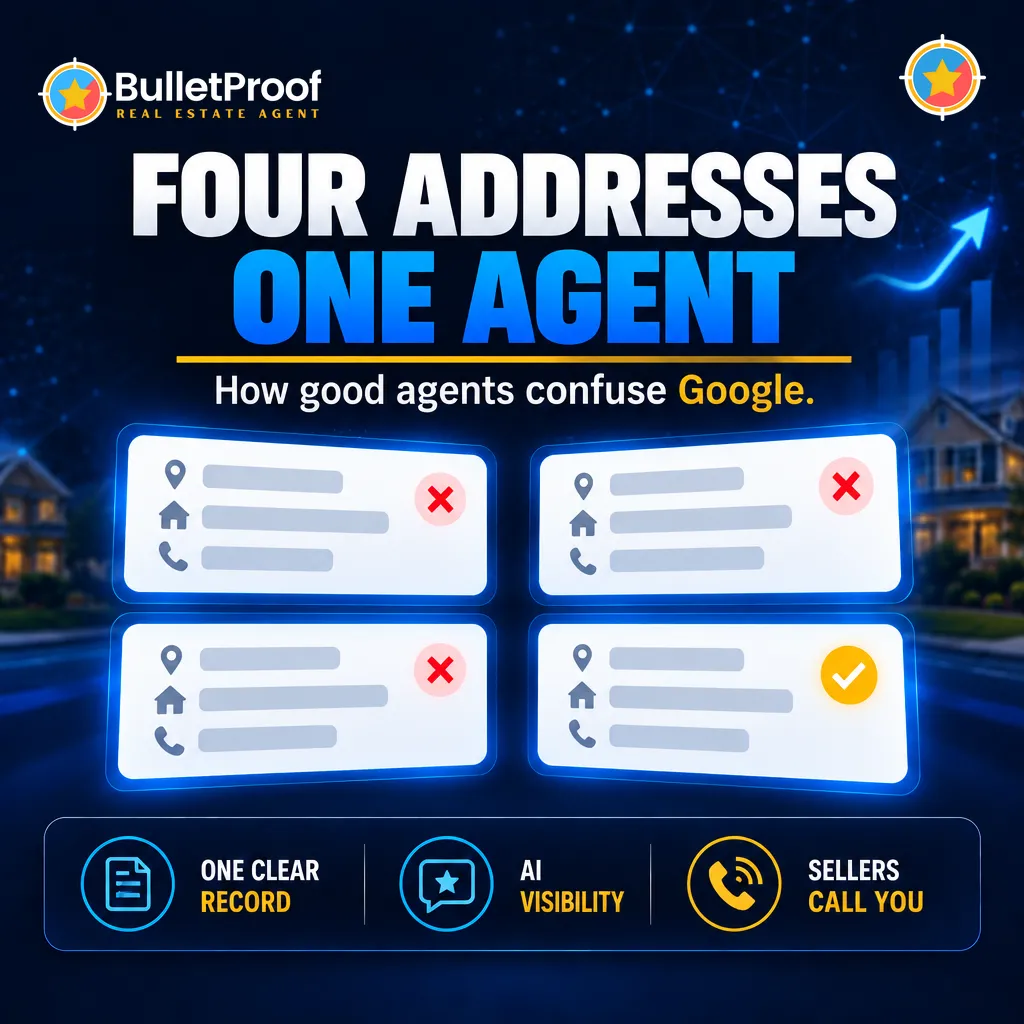
Imagine someone wants to mail you something valuable. They find four addresses with your name on them. Two are old, one has the wrong suite number, one is current.
A careless sender picks one and hopes. A careful sender does not send the package at all, because being wrong is worse than being late.
Search engines and AI answers are careful senders. When the information about you disagrees with itself, the safe move is not to guess which version of you is real. The safe move is to name an agent whose details agree everywhere. Roughly 74% of businesses get excluded from local results over mismatched name, address and phone data. Excluded, not demoted.
Machines don't recommend the best agent. They recommend the one they understand.
Ryan had 250 reviews and sat on page three
Ryan Comstock is the cleanest example of this I know. Twenty years in real estate, a move from Seattle to Tucson, 250 Google reviews. And he was on page three, behind agents with about fifty reviews.
His problem was not effort and it was not reputation. His name, address and phone number did not match across the web. His own description of it: "I was confusing Google."
Once one clean record existed, the first year brought about twenty sales and roughly $250,000, and buyers began arriving from Copilot and Claude — engines that will not cite a business they cannot resolve.
Take a second on that. The experience was always there. The reviews were always there. What changed was whether a machine could tell which Ryan was the real one.
Where the mismatches actually come from
Nobody does this on purpose. It accumulates, usually from perfectly reasonable decisions.
- A brokerage move. The old office address and the old team phone live on in a profile, a bio page and a handful of directories nobody ever revisits.
- A tracking number. Marketing gave you a call-tracking line for one campaign in 2021 and it ended up as your public number in three places.
- A name that shifts shape. Mike on one profile, Michael on another, Mike Smith Group on a third. All true. All different strings to a machine.
- Suite numbers and formatting. Ste 200 versus Suite 200 versus nothing at all; a dash in the phone number here, parentheses there.
- Duplicate profiles. A second Google listing created by a well-meaning assistant, still live, still splitting your reviews and your signals in half.
You were sold your presence in pieces: a website from one vendor, a review tool from another, a profile from the brokerage, directory listings from an aggregator you never chose. Every piece was fine. Nothing connected.
The audit, in about twenty minutes
This is uncomfortable in a useful way, and it costs nothing.
- Write the master record: your name exactly as you want it cited, one address, one phone number that will still ring you in three years.
- Open six places and compare, character by character: your Google Business Profile, your website footer, your website contact page, your brokerage bio, your Zillow or portal profile, one old directory.
- Count the differences. That number is the honest measure of how hard you are to describe right now.
- Search your own name plus your city and look for duplicate profiles, especially from previous brokerages. Claim or remove them rather than ignoring them.
- Fix the master record everywhere, then leave it alone. Stability over time is itself a trust signal; changing your public number twice a year resets the clock.
Why reviews do not rescue a broken record
Reviews are worth roughly 20% of local ranking and Google Business Profile signals roughly 32%, so they matter enormously. But they are attached to a record. If there are two records, or a record the machine cannot confirm, the reviews are weight on a shelf nobody can find.
That is the answer to the question experienced agents keep asking, which is why the newer agent outranks them. The newer agent usually has one profile, one phone number, one address, created once and never confused. Fewer years, cleaner file.
There is a version of this that is almost funny: the golf pro would rather teach someone who has never swung a club than fix twenty years of bad habits. A short, clean history is easier to read than a long, contradictory one. Which means the fix is available to you too — you are just doing cleanup first.
Two more agents, same mechanism
Eric Torres in Arlington, Texas was our first client back in 2022, with hardly any reviews to his name. One clean record, then a steady review habit: 200, then 300, then 400, and come-list-me calls arriving from people who had never met him. He is still a client today.
Mandy Wilson came at it from the expensive end. She was paying roughly $60,000 a year to Zillow, cancelled it, and took seven listings in her first eight months once her own record was the thing doing the work.
Different starting points, same sequence. Resolve the record, then feed it. Neither of them bought their way past the filing problem, because you cannot.
What happens after the cleanup
Fixing the record does not make you the recommendation by itself. It makes you eligible. Then the ordinary work — one review ask a week, a fed profile, real pages about the market you actually sell in — starts compounding on a foundation that holds.
Expect six to twelve months for engines to hand out your name reliably, and expect the first signs on longer questions before the broad one. An agent who would quit at month four should not start.
And partly yes, this is what we do for a living: keep one record straight everywhere, feed the profile, build the pages. But the audit above is yours, free, today, and it will tell you whether you have a marketing problem or a filing problem.
Next spring a seller three streets over types four words at nine at night, reads two sentences about somebody, and decides. Nobody calls to tell you they picked another name. Sellers call you. Not you calling sellers — but only if the machine knows which you to call.
Frequently asked questions
What does NAP consistency mean for a real estate agent?
Name, address and phone number written identically everywhere they appear publicly: Google Business Profile, your website, your brokerage bio, portal profiles and directories. Consistency is what lets an engine resolve all those mentions into one business it can describe.
Can mismatched contact details really keep me off page one?
Yes. Around 74% of businesses are excluded from local results over mismatched name, address and phone data, and AI answers behave the same way — an agent who cannot be resolved is safer to leave out than to name.
Why does a newer agent with fewer reviews outrank me?
Usually because their record is simpler. One profile, one number, one address, no history of brokerage moves or tracking lines. Reviews and experience are weight on a record; they do not fix a record the engine cannot confirm.
Should I delete an old Google profile from a previous brokerage?
Claim it first, then mark it closed or have it merged rather than leaving it live. A duplicate profile splits your signals and gives an engine two competing candidates for the same person.
How long after fixing my details will I see a change?
Early movement often shows in a few weeks on specific, longer questions. Reliable inclusion in broad top agent answers usually takes six to twelve months of consistent work on top of the clean record.
Related reading: I cancelled $60,000 of Zillow. Here is what replaced the leads