
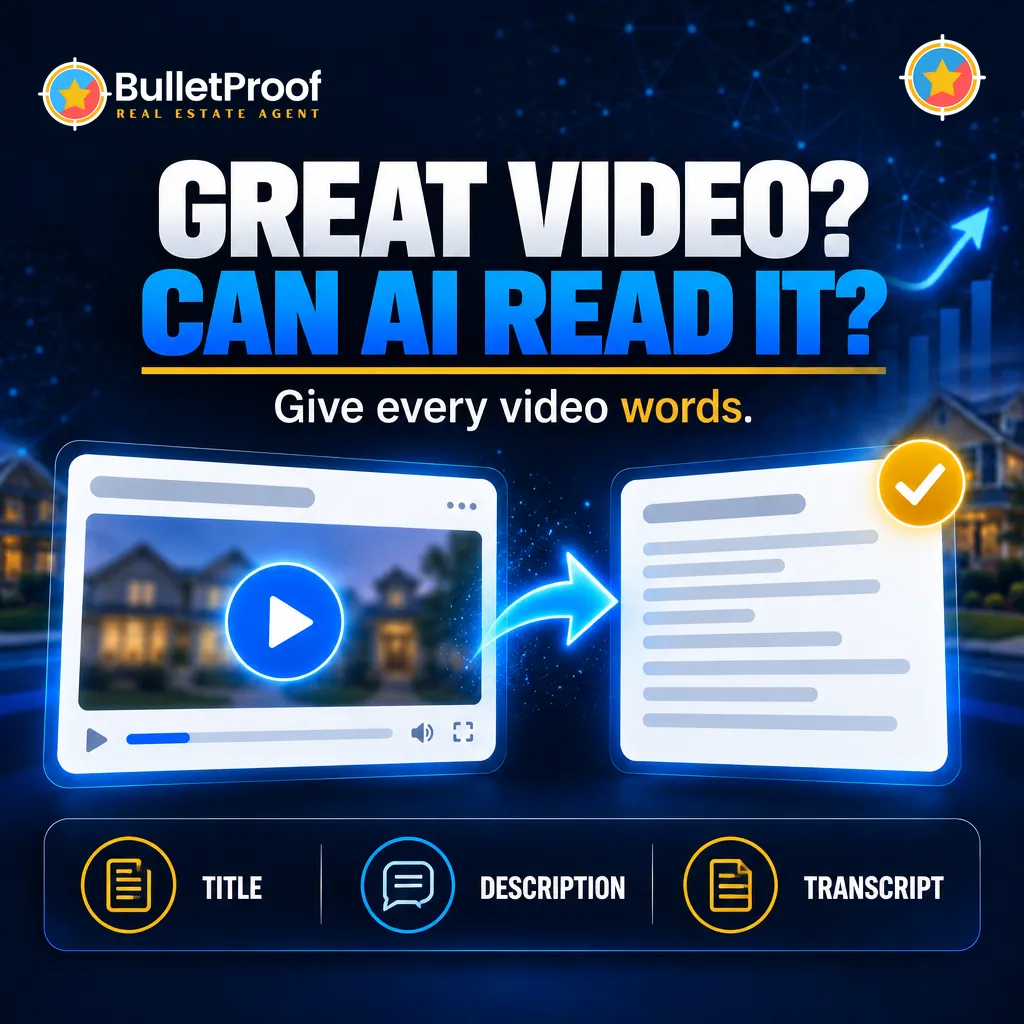
Can Google and AI Read Your Real Estate Videos? Why Transcripts and Titles Matter
You finally did it. You filmed the neighborhood tour, the market update, the answer to the question every seller asks. You posted it. A few people liked it. A friend said you looked great on camera.
Then the views stopped, and nothing about your phone changed. Somewhere in the back of your mind, you wonder if video even works. Am I close?
It does work. You did the hard part, the part most agents never do. The piece that is usually missing is the part a machine can read.
The short answer
Google and AI tools can find your videos, but they understand them mostly through words: the title, the description, the page the video sits on and, best of all, a transcript of what you said. A video with no words around it is a great conversation held in a room the machines can't hear.
AI doesn't pick the best agent. It picks the agent it can understand. Your videos are some of the most firsthand content you will ever make. Give them words, and they start working for you twice.
What Google says about video
Google's own guide to video in search is blunt about one thing: "Just because the watch page is indexed doesn't mean that the video will also be indexed." The same page says the video must be embedded on a watch page. You can read it in Google's video best practices.
In plain terms, posting a video somewhere is not the same as a search engine knowing what it is about. The page around it, and the words on that page, carry most of the weight.
AI tools are similar. When a seller asks ChatGPT, Gemini, Claude, Perplexity, Copilot or another AI tool about agents in her town, the answer is built from what those tools can find and read about you, at machine speed. Text is the easiest thing for them to read and quote.
The video nobody heard
Think of a video without words on the page as a billboard facing a wall. The work is real. The message is good. It is just pointed where nobody can see it.
Here is what that costs. You explain, beautifully, why homes on the east side of [town] sell faster in spring. A seller asks an AI tool that exact question. It can't hear your video, so it quotes an agent who wrote two paragraphs about it. You never find out. Nobody calls to tell you they picked someone else.
How to make every video machine-readable
The good news is that none of this means filming more. It means finishing the videos you already make.
A title that says who, what and where
Say what the video answers, then end with your name, the word Realtor and your town. Our team uses one longtime client, Ryan Comstock, as the example to copy because he does this on nearly every video. If you serve a second town, it is fine to use that too.
A description in full sentences
Two or three sentences on what you cover, the area it applies to and how to reach you. Not a wall of hashtags.
A transcript on the page
Paste what you said, word for word, under the video on your website. Most video tools will generate one for you, so it takes minutes. Then read it once, because automatic transcripts mishear street names. This page does the same thing: the Short below has its full transcript right under it.
Video transcript: Your first showing does not happen at the front door anymore. It happens inside a search bar before a seller ever calls you. They ask who the best agent in town is, they read what comes back, and they decide who to trust. That answer is your new curb appeal. Free visibility audit at joinbulletproof.com. JoinBulletProof.com, where sellers call you. And we'll see you at the top.
A home on your website
Embed each video on a page about that topic, and link the video back to the page. One clear page per video gives the machine one clear story.
Real agents, real video moments
Carol Anne sells in the South Bay area of Los Angeles. On a call this summer she told our team about one of her own videos: "But this one went viral, and it's on Proposition 19, which is a proposition in California regarding property tax and being able to carry over your tax base to your children and grandchildren."
Then she gave us the numbers: "So 170,000 views, mostly from non-followers, over 300 comments, over 4,000 saves, over 4,000 shares, and also private messages and leads."
Look at why that video worked. It answered a specific, local, slightly confusing question that real families have. That is exactly the kind of answer a seller types into an AI tool, and exactly the kind of video that deserves a transcript on a page.
Evan sells in Palatine, Illinois. On an August call, he was quick to ask about a video posted to his Google profile: "Did you see our, our one has like 7,000 views." A video posted where buyers and sellers are already looking keeps getting watched long after a social post would have scrolled away.
If you need topics, start with the real questions local sellers ask on video. Then post the same video to your Google profile too. Our guide to Google profile posts and videos covers how often. And make sure your social profiles point back to your website, so every channel tells the same story.
What we tell our clients about video
Here is our own view, the same thing our VIP managers walk clients through on calls. Film once, then make it readable everywhere.
- Upload every video to YouTube, then have the video point to your website and your website point back to the video.
- End every title with your name, Realtor and your town. It isn't rocket science, and it is one of the most useful habits you can build.
- Put the transcript on the page where the video lives, and read it once for misheard names.
- Spreading uploads a few days apart is fine. Steady beats a burst.
- Answer one real local question per video. A specific answer gets watched, shared and quoted.
Who this is for, and who it isn't
This is for agents who already film, or who are willing to, and want those videos to keep working after the first week. You don't need a studio. A phone and a real answer are enough.
It isn't a shortcut to going viral, and it isn't instant. Six to twelve months to full strength is the honest timeline. A BulletProof website gives every video a home with room for the words. Want to see what Google and AI tools say about you today? Get a free AI visibility audit.
The bottom line
Your videos are proof you were there. Words around them are how machines know it.
AI doesn't pick the best agent. It picks the agent it can understand. Picture next spring. A seller asks a question about her street, and the answer quotes the transcript of your video, with a link to watch you explain it. By the time your phone rings, she has already decided. Sellers call you. Not you calling sellers.
Frequently asked questions
Can Google read the words in my real estate videos?
Google understands videos largely through the text around them: the title, description, the page the video is embedded on and any transcript. Its own guidance notes that an indexed page doesn't guarantee the video itself gets indexed.
Do AI tools like ChatGPT watch real estate videos?
AI tools build answers from what they can find and read about you. Text such as transcripts, titles and descriptions is the most reliable way to make sure what you said in a video can be understood and quoted.
Should I put a transcript under my videos on my website?
Yes. A word-for-word transcript turns your video into text a machine can read. Most video tools create one automatically; read it once to fix misheard names and places.
What should a real estate agent put in a YouTube title?
Say what the video answers, then end with your name, the word Realtor and your town. If you serve a second town, you can use that too.
Is it better to post videos on YouTube or my website?
Both. Upload to YouTube, embed the video on a matching page of your website, and link each to the other. Posting to your Google profile as well helps local buyers and sellers see it.