
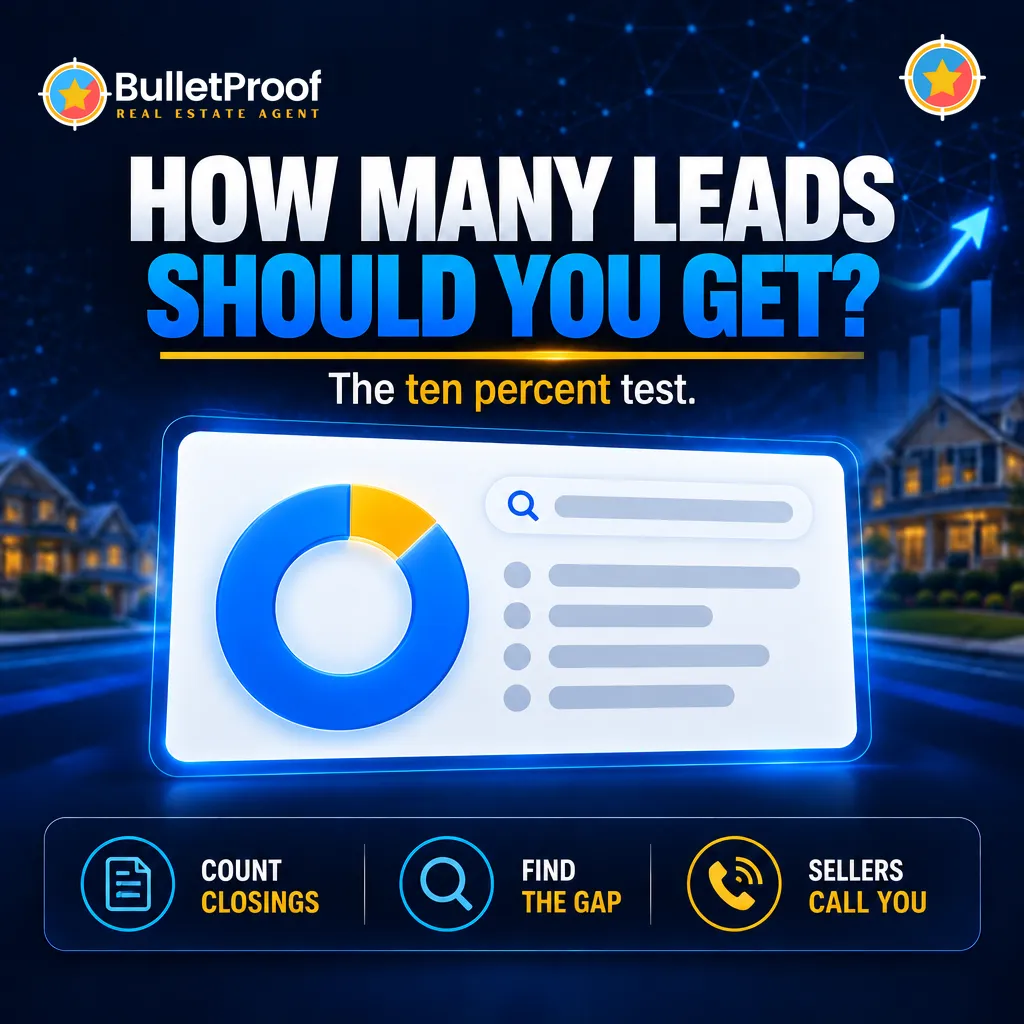
How Many Leads Should a Real Estate Agent Get From Google and AI? The 10% Test
You have been doing this a while. Your past clients like you. Your referrals are steady. And yet, every so often, a quiet question shows up: am I getting as much business from online as I should be?
You hear other agents say Google sends them calls. You see someone post that a seller found them on ChatGPT. And you look at your own phone and think, maybe that only works for other people. Am I close?
It is a fair question, and it deserves a real number instead of a feeling. So let's get you one.
The 10% test
Here is the benchmark we hold to. For a full-time agent, about 10% of your business should come from people who found you online. Not from a portal you paid. Not from your sphere. From someone who searched, found you, and reached out.
Now do the math on your own business. Take your closings from the last 12 months. Take ten percent. If you closed 20, that is two. If you closed 40, that is four.
Then ask yourself honestly how many came from somebody finding you. Not someone you already knew who looked you up. Someone new.
If the answer is close to your 10% number, good. If the answer is zero, nothing about you is broken. Something about how Google and AI read you is. AI doesn't pick the best agent. It picks the agent it can understand.
Video transcript: An agent with 250 reviews was on page three of Google while another agent with 50 reviews was on page one. Why? It took me five minutes to find out and it was nothing that he could have guessed. This happens to good agents all the time, and by good I mean full-time. Three years or more in business, at least 12 to 15 deals a year, agents who already know how to take a listing. Let me show you why. When a homeowner decides to sell today, they don't go ask their neighbor. They open a search box or they ask the assistant on their phone and they call whatever name comes back. That thing cannot interview you. It cannot call your last client. It reads what's out there. Your reviews, your website, your profile, your address, your phone number, and it checks one thing. Does all this describe the same person? Say you move houses. You give the post office your new address. You give your bank a slightly different one. Your old brokerage still has the address from two moves ago. Now, someone who has never met you, they need to reach out to you. Which address are they gonna use? They don't guess. They send it to the person whose address they are sure about. That's what's happening to you. Nobody read your reviews and passed. The machine was not sure, so it handed the seller to someone else that it was sure about. Machines don't recommend the best agent. They recommend the one they understand.
Why most agents never know their real number
Most agents can't answer that question at all, and it is not their fault. Online leads hide. A buyer finds you on Google, then texts your cell. A seller asks ChatGPT, then calls from a number you have never seen. When you ask how they found you, they say "I just looked you up," and it gets written down as a referral.
That is why the first step is to track the lead source that hides. Ask every new client what they searched and where. Write it down. After three months, you will have a real number.
Think of it like a well on your property. If you only ever carry water from the neighbor's house, you will never know whether your own well works. Referrals are the neighbor's water. Good water, and you should keep it. But your own well is the business that shows up whether or not anyone remembers to mention you.
Who the 10% test is for, and who it isn't
This benchmark is for full-time agents with some history: a few years in, a dozen or more deals a year, real reviews from real clients. If that is you, 10% is a fair floor, not a stretch goal.
If you are brand new, or you close three or four homes a year part-time, the math is too small to read yet. Focus on getting your details right and your first reviews in. The test will mean more in a year.
Dale: 10 out of 25
Here is what it looks like when the number is well past 10%. Dale is one of our agents. Halfway through a year, he shared this:
"Out of the 25 of my closings so far this year, 10 came from Google and 7 were listings!"
Ten out of 25 is 40%. And seven were listings, which is the business every agent wants most. That does not happen overnight, and it is not typical in year one. But it shows how high the ceiling can go once Google understands who you are and where you work.
Morgan, Salina, Kansas: when the problem flips
At some point, the question stops being "why don't I get leads?" and becomes "how do I keep up?"
Morgan runs a team in Salina, Kansas. On a July call, she described a typical year: "on a typical year, we do 125 to 150 homes and we're probably doing more than that right now."
Then she said the part every agent wants to be able to say: "And I mean, I feel very blessed with all the business we have. And lately, like we've had more leads than we can actually deal with. So like, that's been pretty cool."
Morgan's team credits a growing community and their own video work for much of that. We are not claiming those leads. We share it because it shows the stage after the 10% test: once the leads come, the work becomes answering them well. We covered that in what happens when real estate inbound leads go cold.
Marcia, Douglasville, Georgia: the 10:30 pm email
Leads do not arrive on your schedule. They arrive when the buyer is ready.
Marcia works Douglasville, Georgia. On a September call, she shared what landed in her inbox the night before: "I literally just got an email last night at 10:30 at night, and she was like, I want to buy right now."
She did the right thing. She called first thing in the morning. "I called her this morning, and she was like, I'm so glad you called me."
Think about that buyer at 10:30 at night. She was not waiting for a postcard. She was searching, deciding, and writing to the agent who looked like the clear answer. If you are not findable at that moment, you never even know you lost her. Nobody calls to tell you they picked someone else.
What to do if you come up short
If your number is well under 10%, here is the plan we use. Three steps:
- Get your details to agree everywhere. Your name, office address and phone number should match on your website, Google profile and every listing site. Mismatched details confuse Google, and about 74% of businesses get left out of local results over exactly that.
- Build reviews steadily. One new Google review a week. Reviews that mention your town and the kind of client you helped give AI tools something specific to quote.
- Answer real local questions on your website and in short videos. Our guide to real estate video ideas that answer local questions shows how one explainer can travel far.
Be honest with yourself about the timeline. This kind of visibility builds over six to twelve months, and it compounds. We broke down why in does SEO still pay off for real estate agents. The agents who quit at month four never find out what month ten looks like.
The bottom line
You do not need to guess whether online is working for you. Run the 10% test. Track every source for three months. Then you will know.
If the number is low, that is not a verdict on you. It is a to-do list. AI doesn't pick the best agent. It picks the agent it can understand. Want to see what other agents built? See real client results, or compare plans on our pricing page.
Picture next year's closings with two, four or ten more that started with a stranger searching your town. That is what we're building toward. Sellers call you. Not you calling sellers.
Frequently asked questions
How many leads should a real estate agent get from Google?
A useful benchmark is that about 10% of a full-time agent's closings should come from people who found them online. Take your last 12 months of closings and multiply by 0.1 to get your number.
How do I know if my leads came from Google or AI?
Ask every new client what they searched and where they found you, and write it down. Many online leads look like referrals unless you ask.
What if I get zero online leads?
Nothing about you is broken. Usually your details do not match across the internet, your reviews are thin, or your website does not say clearly where you work and who you help. Those are fixable.
How long does it take to get leads from Google as an agent?
Plan on six to twelve months for visibility to build. It compounds, so results usually grow faster in the second half of the first year.
Do AI tools like ChatGPT send real estate leads?
Yes. Buyers and sellers ask ChatGPT, Google, Gemini, Claude, Perplexity, Copilot and other AI tools for agent recommendations. AI tools recommend the agents they can clearly understand from consistent information online.