What an AI Visibility Score Actually Measures for Real Estate Agents (and Why It Beats Counting Reviews)
You have been told the game is reviews. Get more reviews, climb the map, get the calls. So you asked. You texted past clients. You sent the link twice. Some of them came through, and you watched the count tick up.
And the phone still did not ring the way it was supposed to. Am I close?
Here is the part nobody tells you. Reviews matter. But reviews are not the first thing a machine checks. The first thing it checks is whether it can tell who you are. That is what an AI visibility score measures, and it explains why some agents with a fraction of the reviews sit above agents with hundreds.
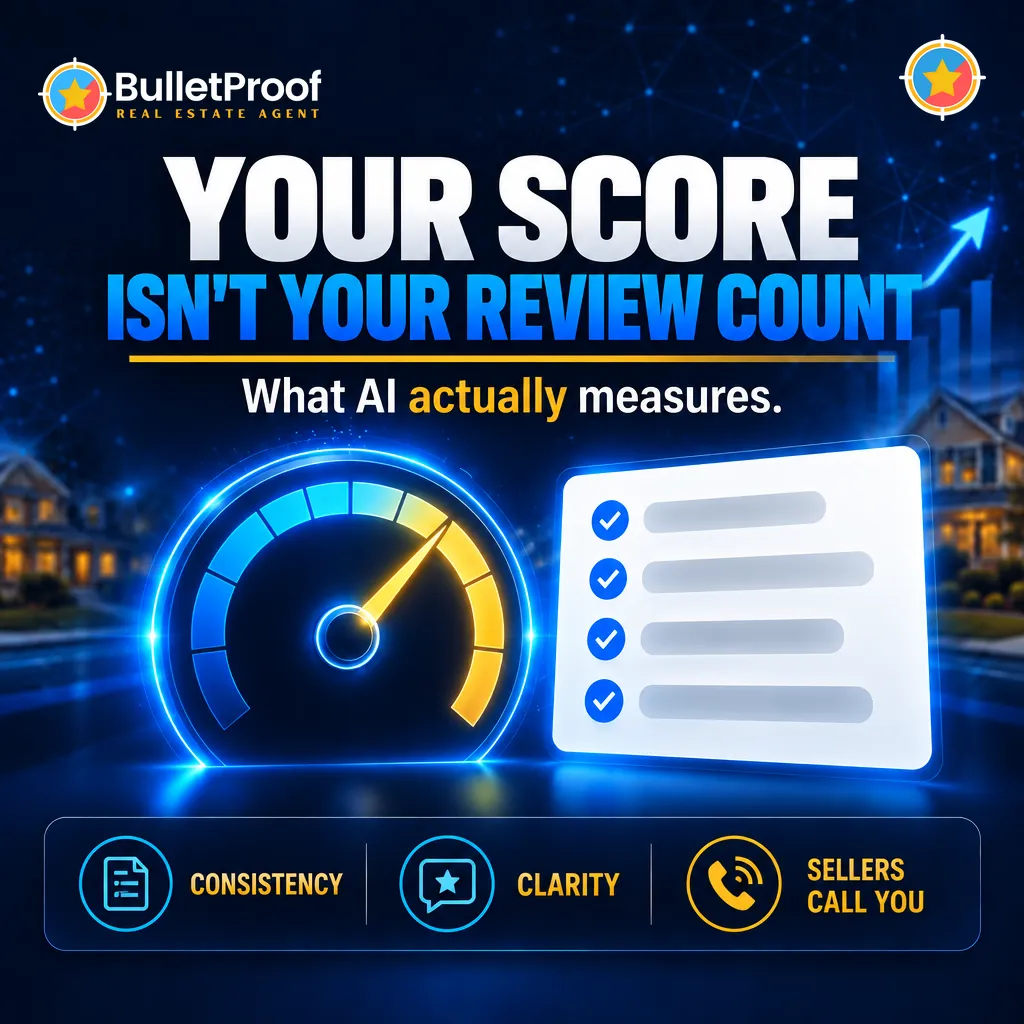
Video transcript: You've been told the game is reviews. It isn't. Before Google or ChatGPT recommends you, it checks one thing first: can it tell who you are, who you serve, and where you work? That's your visibility score. Scott and Melissa opened a brand-new team profile in Asheville with only a handful of reviews. Their score was 94 out of 100, and they landed on page one, just below agents with around 200 reviews. Get the foundation right first. Then the reviews start pulling their weight. Join BulletProof.com, where sellers call you. And we'll see you at the top.
A team in Asheville that was told to stop counting
Scott and Melissa sell homes in western North Carolina. Melissa already had her own profile working in their home lake town. Then the team opened a second profile in Asheville, a much bigger and much more crowded market.
On a call with their BulletProof VIP manager in June, she pulled up the search "Realtor in Asheville." Their new team profile was on the list. "It was down there, like 15 or something," they said.
Then the reflex every agent has: "I need more reviews."
Their manager stopped them. She had just shown them the team's AI visibility score, 94 out of 100. Her words: "there's no question whether or not AI knows who you guys are." She had moved their address over, and the profile was already on the first page. Granted, low on it. But it was sitting just below agents who had around 200 reviews. "This is how you know it's not a review game," she told them.
And then the line that should make every agent stop for a second: "We literally just started this one in Asheville."
A brand-new profile. A handful of reviews. First page in a city full of established names. Later in the same call they mentioned the calls that had started coming in. They were the first calls they had ever gotten where the caller asked for the team by name.
So what does an AI visibility score actually measure?
Think of it like a mail carrier with a letter for you. If your name is spelled three ways, your address is different on every envelope, and nobody wrote down which street you live on, the letter goes back. Not because you don't deserve the mail. Because nobody could be sure it was you.
Google and ChatGPT work the same way. Machines don't recommend the best agent. They recommend the one they understand. A visibility score is a measure of how well they understand you. Here is what goes into it.
1. Can they confirm who you are?
Your name, brokerage, phone and address need to match everywhere you appear: your website, your Google profile, the directories, your brokerage page. When they disagree, the machine has to guess. When it has to guess, it picks someone else. Mismatched contact details quietly push you down, no matter how many reviews you have.
2. Can they tell who you serve?
"Real estate agent" is not a description a machine can use. Sellers on acreage, first-time buyers, downsizers, relocations, one neighborhood, one lake. The clearer your pages say it, the more searches you can be the answer to.
3. Can they tell where you work?
The service area has to be written down, on your site and your profile, in words a machine can read. This is exactly what changed for Scott and Melissa. The Asheville address went in, and the profile showed up in Asheville.
4. Is your website written for machines as well as people?
Structured data, clear headings, plain answers to the questions sellers actually ask. A site that is just a search bar and a headshot gives a machine almost nothing to quote. That is a big part of how AI decides which agent to recommend.
5. Do outside sources agree with you?
Reviews that mention your town and the kind of sale. Press mentions. Directory listings. Your brokerage bio. Every outside source that repeats the same story makes the machine more confident. This is where reviews come back in, and where they finally start to do their real work.
Why the score comes first and reviews come second
Reviews are fuel. The score tells you whether the engine is connected.
If a machine is not sure who you are, a hundred more reviews just pile up on a profile it cannot place. That is why more reviews didn't rank you, and why BulletProof regularly takes on agents with hundreds of reviews who are nowhere to be found.
When the machine is sure, every new review counts. Scott and Melissa's manager told them the same thing in the same call: now that the foundation was in place, reviews mattered "100%," and the momentum was the time to ask. The order matters. Foundation, then fuel.
You are not behind. You were measuring the wrong thing.
If you have been grinding on review asks and wondering why nothing moved, nothing is wrong with you. You were doing what the old advice told you. It just skipped the step the machines care about first.
Grace Globus went from no Google profile at all to 120 reviews in six to eight months in Santa Monica and Beverly Hills, because the foundation came first. Ryan Comstock had 250 reviews and was stuck on page three until the mismatched addresses and phone numbers were fixed. In his words, "I was confusing Google." Same reviews. Different result once the machine could read him.
Your brokerage bio, your old directory listings and your Google profile are all telling the machine something about you. The question is whether they are telling it the same thing. If you are relying on the brokerage page to do this work, read why your brokerage bio is not your own AI visibility.
What a good score does not do
Honesty matters here. A score is not a ranking and it is not a guarantee. It tells you the machine can read you. It does not make sellers move. You still need reviews, you still need to answer the phone fast, and you still need to give it time. Plan on six to twelve months of steady work before the calls become regular. Some agents see the first ones sooner, like Scott and Melissa did. Most need the full stretch.
What the score does is tell you where the leak is. A low score with lots of reviews means fix the foundation first. A high score with few reviews means go get the reviews, because the machine is ready to use them.
Find out what the machines can read about you
Ask ChatGPT who the best agent in your town is. Then ask it about you by name. If the answer is vague, wrong or missing, you have a foundation problem, not a review problem. To see your own score and exactly what is dragging it down, get an AI visibility audit. If the gap is your site, a BulletProof website is built to be read by people and machines alike.
Get the foundation right and the reviews start pulling their weight. Sellers call you. Not you calling sellers.
Frequently asked questions
What is an AI visibility score for a real estate agent?
It is a measure of how clearly Google and AI tools like ChatGPT can identify who you are, who you serve and where you work, based on your website, Google profile, directories, reviews and other sources.
Is an AI visibility score the same as my Google ranking?
No. Ranking is where you appear for one search. The score measures whether machines understand you well enough to show you at all. A strong score makes better rankings possible but does not guarantee them.
Can I rank on page one without a lot of reviews?
Yes. When your details match everywhere and your pages clearly say who and where you serve, you can sit above agents with many more reviews. Reviews still matter, and they do more once the foundation is in place.
What lowers an AI visibility score?
Mismatched names, phone numbers or addresses, no written service area, a website with little readable text or structured data, and outside sources that describe you differently.
How do I check my AI visibility score?
Run an AI visibility audit. It shows what Google and AI can read about you today and lists the specific fixes that would raise it.
Related reading: Google Local Services Ads vs. AI answers: why agents need both