Same Name as Another Real Estate Agent? How to Keep Google and AI From Mixing You Up
A seller hears your name from a neighbor. She types it into Google that night. Up comes an agent with your name, but a different face, a different brokerage and a town two counties away.
She isn't sure which one she was told about. So she reads the reviews of the one she found, and maybe she calls that one.
If you share a name with another agent, or even a close version of it, you've probably had a moment like this. A call meant for someone else. A review that landed on the wrong profile. A friend asking why you moved offices. Am I close?
Why a shared name is a real problem now
For years a shared name was a funny story. Now it costs you business, because so much of the choosing happens before anyone calls.
Sellers search your name to check you out. Google decides which profile to show. And when a seller asks ChatGPT, Gemini, Claude, Perplexity, Copilot and other AI tools about you, those tools pull together everything they can find under that name. If two agents' details are mixed in the pile, the answer can come out blurry, or point to the wrong person.
This is not about you doing anything wrong. You didn't pick your name. The machine just needs more clues to tell the two of you apart. AI doesn't pick the best agent. It picks the agent it can understand.
Your name is the search
Here is what makes this so important. Referrals don't skip the search anymore. They start it.
Amy, an agent in Crown Point, Indiana, told us what one new client said when they first spoke: "I saw your name, I Googled you, and I read your reviews, and I knew I wanted to talk to you at least." Name, then Google, then reviews, then the call. That is the path.
Pattie, who sells in Southern Maine, sees the same thing. "One recent sale came as a result of my reviews. They just Googled me." And on another sale: "So my webpage, they looked at it, looked at the reviews, and they said, she's quality."
Now picture that same path when the search shows someone else first. The referral was yours. The reviews they read were not.
What mixed signals cost one agent
Ryan had 20 years in the business and 250 reviews. He was still stuck on page three while agents with about 50 reviews sat on page one. The cause wasn't his work. His addresses and phone numbers didn't match from one profile to the next. He was confusing Google.
A shared name works the same way, only worse. Instead of your own details disagreeing with each other, another agent's details are mixed in with yours. Fixing it starts the same way Ryan's did: the same contact details everywhere, so every profile tells one story. You can see more stories like his in our client case studies.
What Google asks of your name
Google's own guidelines for Business Profiles are clear. They say: "Your name should reflect your business's real-world name, as used consistently on your storefront, website, stationery, and as known to customers."
The same page warns against stuffing extra words in: "Including unnecessary information in your business name isn't permitted, and could result in the suspension of your Business Profile." So the fix is not adding "Best Realtor in [town]" to your name. The fix is using your real name the same way everywhere, and letting everything around it make you easy to tell apart. You can read the full Google Business Profile guidelines on Google's help site.
The call that went to the other agent
Here is the hard part. When a seller calls the wrong agent with your name, you never hear about it. She doesn't know she made a mistake. The other agent doesn't call to tell you. Nobody calls to tell you they picked someone else.
And if this has happened to you, nothing about you is broken. Your reputation is real. It just needs a clearer label.
How to make your name point to you
1. Pick one version of your name and never change it
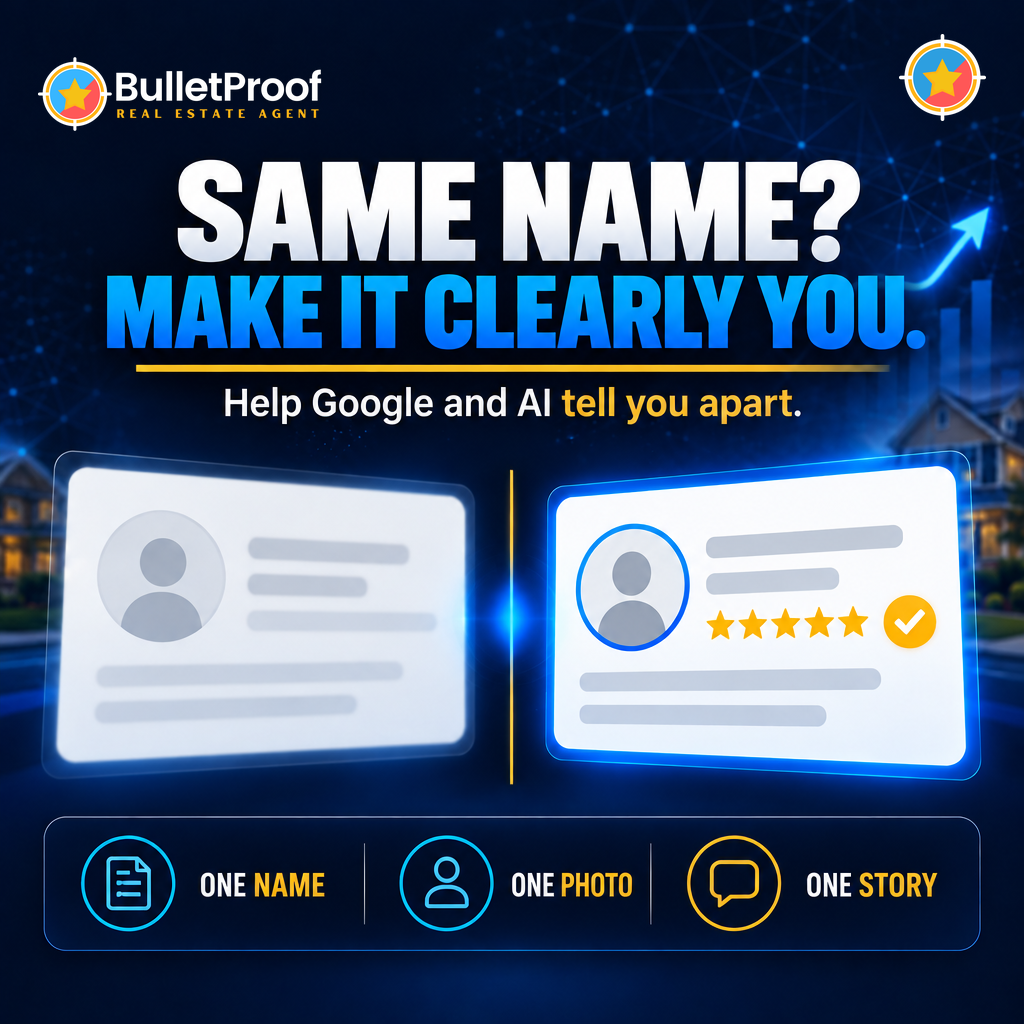
Full first name or nickname, middle initial or not. Choose one and use it on your Google profile, website, social accounts, directory listings and email signature. If the other agent has your exact first and last name, a consistent middle initial can help sellers and machines tell you apart.
2. Put your towns right next to your name
"[first name] [last name], Realtor in [town]" is far easier to place than a name alone. Use the same towns everywhere, so your name and your market always travel together.
3. Use one headshot everywhere
A seller who sees the same face on Google, your website and your social profiles knows she found the right person. A face is the fastest way to tell two agents apart.
4. Make your website the home base
Your about page should say who you are, where you work, your brokerage, how long you've been at it and what you're known for. It helps to have an agent bio Google and AI can read, with every profile linking back to it.
Then check it every quarter. Search your own name, ask an AI tool who you are, and note anything that belongs to the other agent. Our guide to agent personal branding covers the bigger picture of how your name becomes your reputation.
Video transcript: So, how do I get Google to show my name first like it does for your agents? Visit joinbulletproof.com, and we'll see you at the top.
What we tell our clients about a shared name
Here is our own view, the same thing we tell the agents we work with.
- You don't need a new name. You need a consistent one. Keep the name sellers already know and use it the exact same way everywhere.
- Details are the tiebreaker. Your towns, brokerage, phone, headshot and specialty are what tell Google and AI which agent is which.
- We keep your name, phone and address matched across 50+ online profiles, including maps and AI assistants, so every one of them points to the same agent.
- Reviews that mention your name and your town help. Here is the number we hold to: one new Google review a week.
- Be patient. Full strength takes six to twelve months. Our guarantee is page 1, the top 20 agents in your market, within 12 months. We never promise a number of deals.
Who this is for, and who it isn't
This is for any agent who has ever had a call, a review or a referral meant for someone else, or who has a common name in a busy market. It matters most when the other agent works nearby.
It isn't about competing with the other agent or asking them to change anything. You can only control your own signals, and that is enough. Your profiles work best when they point back to a website built to be read. To see what Google and AI say when someone searches your name today, get a free AI visibility audit.
The bottom line
Your name is the first thing a referral types. Make sure it leads to you: one name, the same face, your towns beside it and a website that ties it all together.
AI doesn't pick the best agent. It picks the agent it can understand. Picture next spring. A neighbor mentions you at a barbecue. The seller searches your name that night, sees your face, your town and your reviews, and knows she has the right agent. By the time your phone rings, she has decided. Sellers call you. Not you calling sellers.
Frequently asked questions
What should I do if another real estate agent has the same name as me?
Use one exact version of your name everywhere, put your towns and brokerage beside it, use the same headshot on every profile, and keep your contact details matched so Google and AI can tell you apart.
Should I change my name on Google to stand out?
No. Google asks that your profile name match your real-world name, and adding extra words like a city or a slogan isn't permitted and can lead to suspension.
Can ChatGPT confuse me with another agent?
It can blend details when two agents share a name and their information is scattered. Clear, consistent details on your website and profiles give AI tools fewer chances to mix you up.
Does a middle initial help?
It can, if you use it every time. A consistent middle initial, plus your towns and headshot, helps sellers and search tools separate you from another agent.
How do I check whether I'm being mixed up with someone else?
Search your own name on Google, ask a few AI tools who you are, and look for wrong photos, phone numbers, towns or brokerages. Fix what you control, starting with your own profiles.
Related reading: FSBO sellers who decide they want an agent: how they find one