Zillow, Realtor.com and Directory Profiles: What Google and AI Read About You
Search your own name and your town. Go ahead, take ten seconds. Chances are your website is there, your Google profile is there, and right under them sit three or four profiles you set up years ago. A Zillow page. A Realtor.com page. Maybe Homes.com, Yelp or an old brokerage roster.
Now open them. One has the phone number you dropped in 2021. One still shows your old brokerage. One has a headshot from a different decade, and one says you serve a town you stopped working in. You meant to fix them. There was never a day. Am I close?
You are not careless. Nobody told you that those forgotten pages are part of your reputation. They are, and machines read every one of them.
The short answer
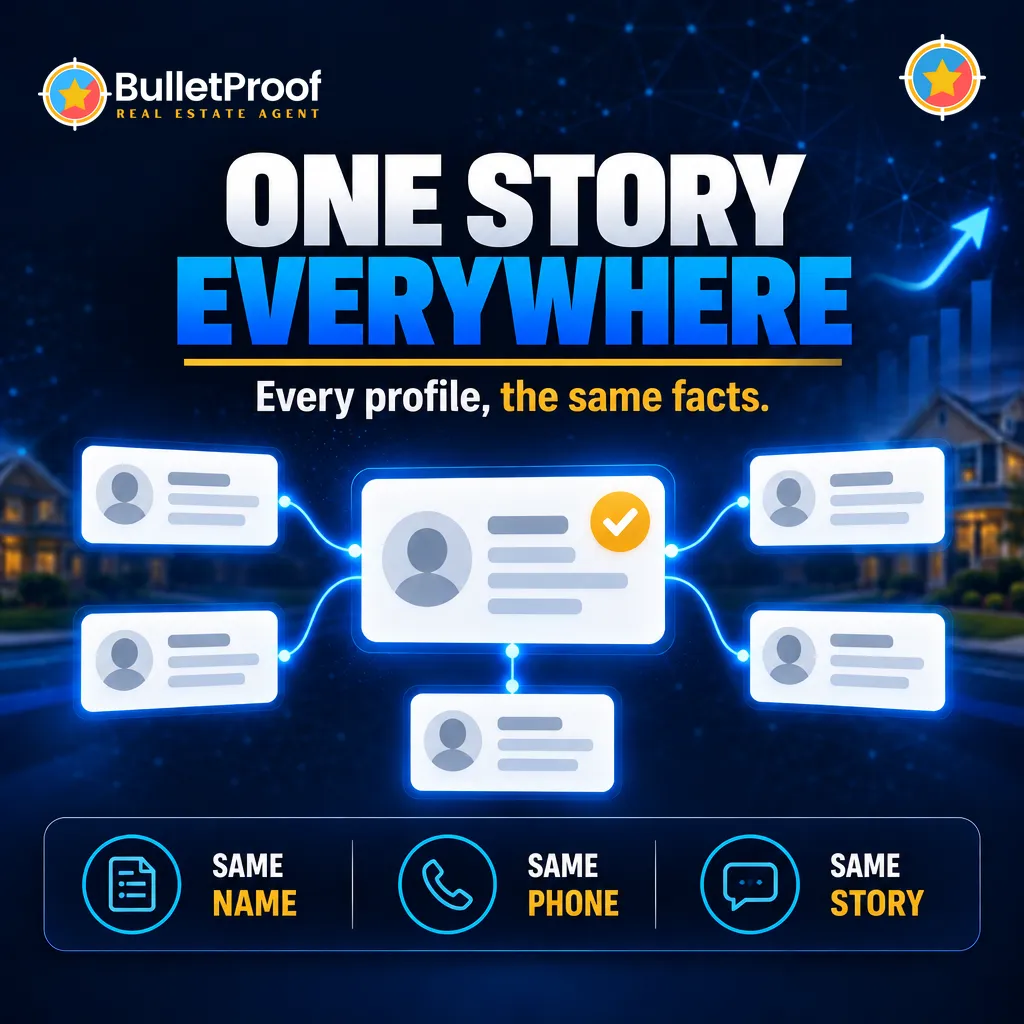
Google and AI tools build their picture of you from everything they can find, not just your website. Directory and portal profiles such as Zillow, Realtor.com, Homes.com, Redfin, Yelp, Apple Maps, Bing and your brokerage roster are part of that picture. When they all show the same name, phone, office address, service area and short bio, the picture is clear. When they disagree, it gets blurry, and a blurry agent is a hard agent to recommend.
AI doesn't pick the best agent. It picks the agent it can understand. Your directory profiles are a big part of how it understands you.
Why directory profiles matter to Google and AI
Google's own help page on local ranking says prominence is part of how it ranks businesses, and that it is based partly on information like how many websites link to your business and how many reviews you have. Every profile that mentions you is one more place that vouches for you, as long as it says the same thing.
AI tools work the same way, only more so. ChatGPT, Google's AI answers, Gemini, Claude, Perplexity, Copilot and other AI tools try to confirm a fact from more than one source before they repeat it. If five profiles say you sell in one town and two say another, the machine has to guess. Often it names someone else.
Think of it like references on a job application. One great reference helps. Five references who all describe the same person get you hired. Five references who each describe someone slightly different make the employer nervous, even if every one of them is kind.
Video transcript: Your next seller isn't scrolling Zillow. They're asking ChatGPT who to call. And here's what nobody tells you. Artificial intelligence doesn't recommend the best agent. It recommends the one it understands. If it can't read you, it skips you. And you never even know that call existed. Sellers call you, not you calling sellers. Get your free visibility audit at JoinBulletProof.com.
Which profiles matter most
You don't need to be everywhere. You need to be correct in the places that matter. In order of priority:
1. Your website and your Google profile
These are the source of truth. Every other profile should copy them, word for word on the basics. A BulletProof website is built to be that source, so every other profile has one clear version to match.
2. The big real estate portals
Zillow, Realtor.com, Homes.com and Redfin profiles often show up on page one when someone searches your name. Sellers click them. Fill in the bio, service areas, headshot, license details and recent sales, and keep your phone and office address identical to your website.
3. Maps and local directories
Apple Maps, Bing, Yelp, Nextdoor and the other local directories feed phones, voice assistants and AI tools. These are the ones agents forget, and the ones that quietly hold an old phone number for years.
4. Brokerage and association pages
Your brokerage roster and your local association directory carry authority because they confirm you are licensed and active. When you change brokerages, these are the pages that go stale first. Here is how to change brokerages without losing your online visibility.
How to fill in a profile so machines can read it
- Use one name, spelled the same way everywhere. If your sign uses a nickname, decide whether you go by the nickname or your full name online, and stick to it.
- Use one phone number and one office address, copied from your Google profile.
- Name your service areas plainly: the towns and neighborhoods you actually sell in.
- Open your bio with facts, then the warmth: who you help, where, and for how long. Here is how to write an agent bio Google and AI can actually read.
- Use the same headshot, and link back to your own website wherever the profile allows it.
That is the whole job. It is not glamorous. It is the kind of work that pays off because almost nobody does it.
What this looks like for real agents
Ryan Comstock had been selling for 20 years and had 250 reviews, and he was still stuck on page three while agents with about 50 reviews sat on page one. The cause was not his work. It was mismatched addresses and phone numbers across his profiles. In his words, "I was confusing Google." Once the details matched, he closed 20 sales in his first year and 24 online deals in 2025, with buyers finding him through Copilot and Claude. Here is the full story of how mismatched contact details quietly cost agents listings.
Carey sells in Concord and Charlotte, North Carolina. On a call in September, talking about a buyer who had come to her, she told us: "But Redfin had said they probably just found me through AI, by the way." Portals, AI tools and your own profiles are all part of the same web now. A buyer can start in one and end up at your door through another.
Cheryl Ann sells in Heber Springs, Arkansas. On an August call, when our team checked, ChatGPT named her first for her town. On the same call she told us about a new listing: "she found me online... and we've already got that in contract."
None of these agents became better agents overnight. Their profiles finally told the same story, so machines could repeat it with confidence.
What we tell our clients about directory profiles
Here is our own view, the same thing our team says on client calls. Your profiles are not marketing. They are evidence. Every one either confirms who you are or contradicts it.
- Your website and Google profile come first. We set those up as the master copy, and everything else matches them.
- We push your core details out to more than 50 online profiles for you, from maps apps to the directories voice assistants and AI tools read, so you don't fix them one at a time.
- Portals you log into yourself, like Zillow, Realtor.com, Homes.com or HomeLight, we update when you share the login. No login, no update, so we ask.
- When something changes, a new office, a new phone, a new brokerage, we change it everywhere in one pass. Half-updated profiles are worse than old ones.
- Check your name in a private browser window twice a year. If a profile says something you wouldn't say, tell us.
Who this is for, and who it isn't
This is for agents who do good work but show up as three slightly different people online. Cleaning up profiles won't replace reviews, a real website or time in the market. It is the foundation those things sit on. The whole picture takes six to twelve months to reach full strength.
Want to see what your profiles tell sellers and AI tools right now? Get a free AI visibility audit.
The bottom line
Somewhere right now, a seller is checking you on a portal you forgot you had. What she reads there either matches everything else or it doesn't. Nobody calls to tell you they picked someone else because your old number rang through to nobody.
AI doesn't pick the best agent. It picks the agent it can understand. Picture next spring: a seller asks her phone for the best agent in her town, every source agrees about you, and the answer comes back with your name. By the time your phone rings, she has decided. Sellers call you. Not you calling sellers.
Frequently asked questions
Do Zillow and Realtor.com profiles help my Google ranking?
They help indirectly. Portal profiles often rank for your name, and when they match your website and Google profile, they confirm who you are and where you work. Mismatched details do the opposite.
Which directory profiles should a real estate agent claim?
Start with your website and Google profile, then Zillow, Realtor.com, Homes.com and Redfin, then maps and local directories like Apple Maps, Bing, Yelp and Nextdoor, then your brokerage and association pages.
Do AI tools like ChatGPT read directory profiles?
AI tools such as ChatGPT, Gemini, Claude, Perplexity and Copilot draw on information from across the web. Profiles that agree with each other give them more confidence to name you.
What should match across all my profiles?
Your name, phone number, office address, service areas, headshot and the opening of your bio. Copy them from your Google profile so every version is identical.
How often should I check my directory profiles?
At least twice a year, and right away after any change to your phone, office or brokerage.
Related reading: The FAQ page AI can quote: how real estate agents should write one