Lake and Resort Town Agents: How to Get Found by Second-Home Buyers and Sellers
You know your lake. Every cove, every road that floods in spring, which docks get the afternoon sun and which neighborhoods go quiet in the winter.
But a lot of the people buying and selling around you don't live there full time. They're three hours away, or three states away. They visit in the summer, and when it's time to buy or sell, they pick an agent from a screen. If your name doesn't come up, someone else's does. Am I close?
That isn't a knock on your work. In a resort market, the people who need you most are often the ones who have never met you.
Why lake and resort markets are different
In most towns, a seller has driven past your signs for years. In a lake town, the owner of the place on the water may only see your signs a few weekends a year.
So they search. "Best realtor on the lake." "Who sells lake homes near me." Or they ask ChatGPT, Gemini, Claude, Perplexity, Copilot and other AI tools who they should hire. Then they read your reviews, look at your website and decide, all without setting foot in your office.
Here's a quick check. Think about your last ten closings on or near the water. How many of those clients lived somewhere else when they first reached out? If you don't know, ask the next one how they found you, and write it down.
AI doesn't pick the best agent. It picks the agent it can understand. In a resort market, the agent it can understand is the one whose name is clearly tied to the lake and the towns around it.
What Google says about being well known
Google's help page about how local ranking works lists prominence as one of the main factors: "Prominence means how well-known a business is. Prominent places are more likely to show up in search results. This factor's also based on info like how many websites link to your business and how many reviews you have."
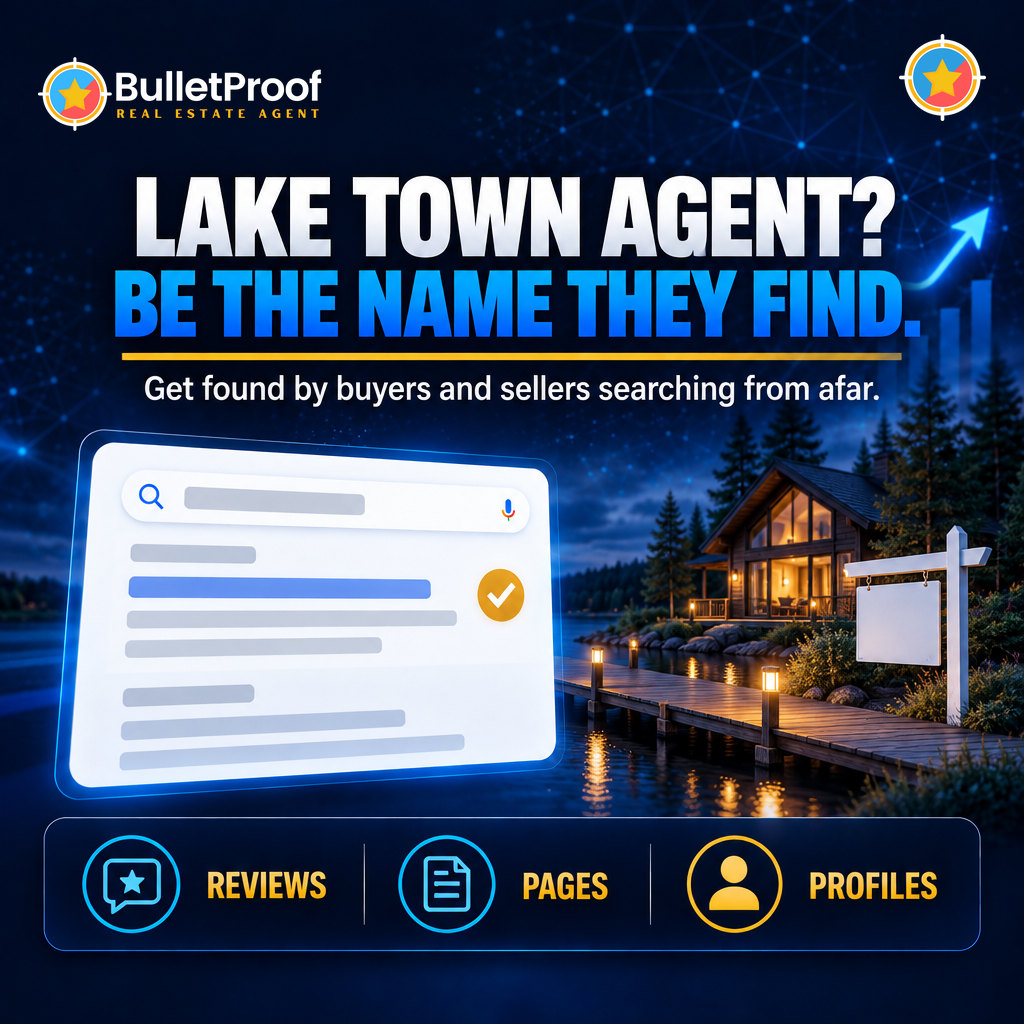
Read that with a lake market in mind. Being well known at the marina isn't the same as being well known online. The reputation you've built over years has to be written down where Google and AI can find it: reviews, pages, profiles and mentions that tie your name to the water.
Video transcript: How do you get Google to recommend my competitors like that? If you're serious, it's time you joined BulletProof, and we'll see you at the top.
Lake market agents who get found
The team at Sunrise Beach, Missouri, on Lake of the Ozarks, described the change in their Google calls on a September call: "we had like maybe four a month and now we're getting like four plus a week." And the part that matters most: "they're actually like turning into stuff."
Kristina and Scott sell in Lake Havasu City, Arizona. In late September they told us about their first deal "from somebody calling off of ChatGPT." It was a seller. "She interviewed a few agents. We got the listing."
Pattie sells around the Sebago Lake region of Southern Maine. She put it simply: "One recent sale came as a result of my reviews. They just Googled me."
Mike sells in Huntersville, North Carolina, on Lake Norman. A seller "just typed in Google and said, who's the best realtor in Huntersville? And I popped up, he read the reviews, and was like, all right, let's give this guy a chance."
Four lake markets, one pattern. The client decided from a screen, based on what they could read about the agent. You can see more stories like these in our client case studies.
How to become the name people find for the lake
1. Use the lake's name the way people search
People don't search for your county. They search for the lake, the town on the lake and the area everyone calls it by. Put those exact names on your Google profile, your website and your bio, the same way every time.
2. Give the lake its own pages
A page about buying on the lake, a page about each town around it, and plain answers to the questions owners ask you every summer. If you have never built one, start with a neighborhood page AI can read.
3. Ask for reviews that mention the lake
A review that says "she knew every cove on the lake and sold our place in a week" tells the next seller, and the machine, exactly what you're known for. "Great agent" doesn't.
4. Keep working when the season ends
The visitors go home, but they keep thinking about the lake. Winter is when you build the pages and reviews that get you found in spring. We cover that in what to do in the slow season.
Many of these buyers and sellers are deciding from far away, which is a lot like the clients we describe in how relocating buyers and sellers choose an agent.
What we tell our clients in lake and resort markets
Here is our own view, the same thing we walk through with agents whose market lives on the water.
- Your name and the lake belong together. Every profile, page and bio should make it obvious that you are the agent for that lake and those towns.
- Match your details everywhere. We keep your name, brokerage, phone and address the same across 50+ online profiles, including maps and AI assistants, so nobody gets a mixed story.
- Hold a steady review pace. Here is the number we hold to: one new Google review a week, all year, not just in summer.
- Write for the person who isn't there. Assume the reader is three states away and has never met you. Tell them what they would want to know before they call.
- Be honest about time. Full strength takes six to twelve months. Our guarantee is page 1, the top 20 agents in your market, within 12 months. We never promise a number of deals.
Who this is for, and who it isn't
This is for agents in lake, beach, mountain and other resort towns who know their market better than anyone and want the people searching from far away to know it too.
It isn't a reason to stop doing what built your name locally. The marina, the community events and the people who know you still matter. This just makes sure the owner three states away can find you too. If you want to see what they find about you today, get a free AI visibility audit.
The bottom line
In a resort market, the people who need you most often live somewhere else. They choose from a screen, before they ever meet you. Make sure your name, your lake and your reputation are written down where they look.
AI doesn't pick the best agent. It picks the agent it can understand. Picture next spring. A family three states away decides it's time to sell the lake house. They ask who knows the lake best, read what your past clients wrote about you, and by the time your phone rings they have already decided. Sellers call you. Not you calling sellers.
Frequently asked questions
How do second-home buyers find a real estate agent?
Many search Google or ask AI tools like ChatGPT, Gemini, Claude, Perplexity and Copilot for the best agent on the lake or in the resort town, then read reviews and look at the agent's website before calling.
How can a lake area real estate agent show up on Google?
Use the lake's name and the town names the way people search, keep your details the same everywhere, build pages about the lake and its towns, and earn steady reviews that mention the lake.
Do vacation home sellers hire agents they have never met?
Often, yes. Owners who live elsewhere usually choose from what they can read online, which is why reviews, a clear website and matched profiles matter so much in resort markets.
Should I make separate pages for each town around the lake?
If people search for those towns by name, yes. A page for each town, with real details and answers to common questions, gives Google and AI something specific to match.
How long does it take to get found in a resort market?
Plan on six to twelve months to full strength. Reviews, pages and matched profiles build on each other over time, including the off-season.