Google Ads vs Organic Search for Real Estate Agents: Where Should Your First Dollar Go?
You have a marketing budget and a nagging question. Do you pay Google for clicks right now, or do you put the money into being found without paying for every visit?
Maybe you tried ads once. The clicks came, the calls didn't, and you were left wondering whether the problem was the ad, the budget or you. Or maybe you skipped ads because organic felt slow and vague. Am I close?
Either way, nothing about you is broken. Most agents were never shown how the two actually work together. So let's lay it out plainly.
What you are actually buying with Google Ads
Google is clear about the deal. Its own definition of cost-per-click says: "Cost-per-click (CPC) bidding means that you pay for each click on your ads."
That is the whole model. You are renting attention, one click at a time. It can be fast. It can be useful. But the day the budget stops, the clicks stop with it. Nothing you paid for keeps working for you next month.
Organic visibility is different. Your Google profile, your reviews, your website and the facts AI tools read about you keep working after you stop touching them. They are slower to build. They also don't send you a bill every time a seller looks. And every review and every page builds your name, not just a click.
A tap and a well
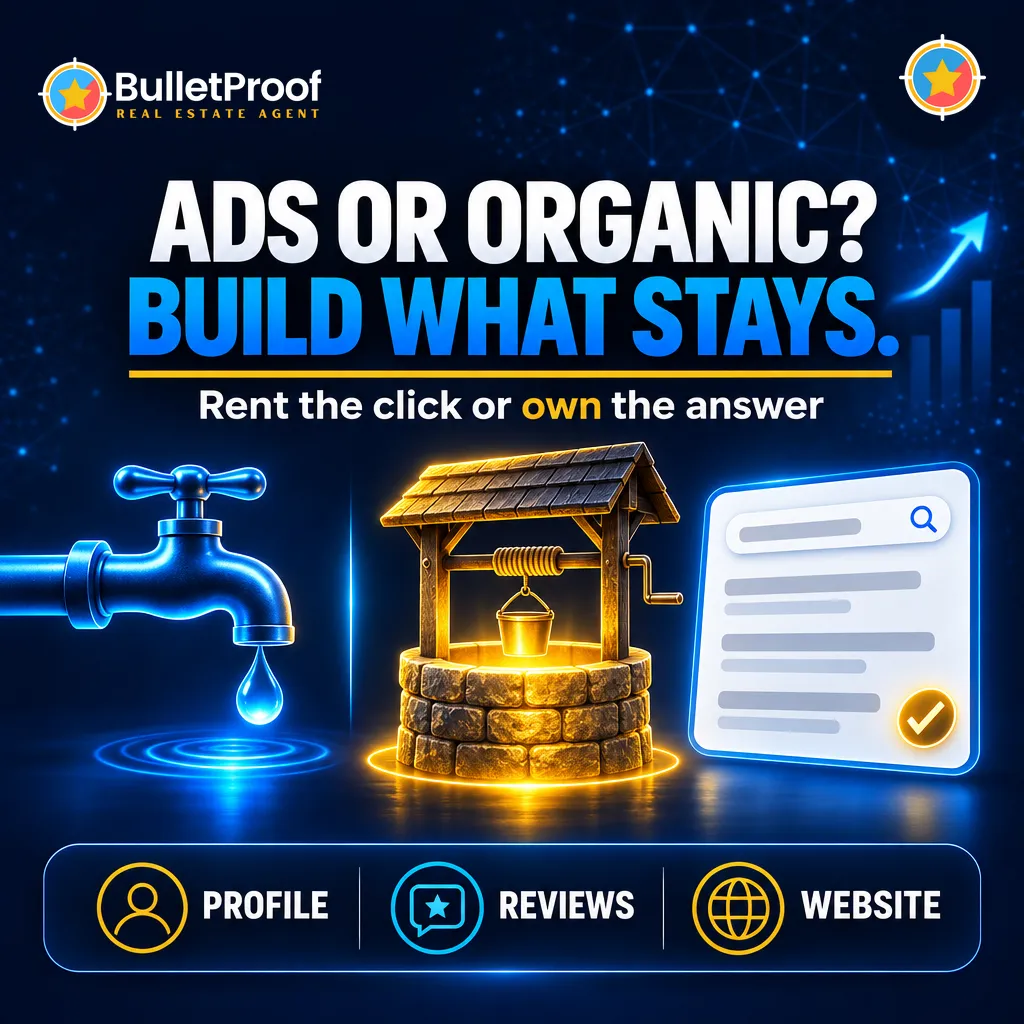
Think of ads as a tap and organic as a well. A tap gives you water the minute you turn it on, and it costs you for every glass. A well takes digging. Once it's dug, it keeps filling whether you're watching or not.
Video transcript: Okay, this is between us. Most agents aren't losing listings because they're bad at real estate. They're losing them before the conversation even starts. Because when a seller searches on Google, or asks ChatGPT who to hire, they're choosing from the agents they actually see. And if you're not there, you're not getting the call. Visibility gets the click. Authority gets you recommended. Trust gets the come list me call. Follow for more ways to make sure sellers call you.
Most agents are carrying water by hand. They pay for clicks every month, then wonder why nothing is left when they pause. The fix isn't to swear off the tap. It's to dig the well first, so the tap is a bonus and not a lifeline.
A two-minute test before you spend
Grab last year's closings. Next to each one, write how that client found you. Referral, sign call, ad, or someone who searched and picked you.
Now ask yourself one honest question. If your ad budget went to zero for the next 90 days, which of those would still happen? About 10% of a full-time agent's business should come from people who found them online. If that line on your list is close to empty, the well hasn't been dug yet.
That isn't a judgment. It's a starting point. It tells you where the next dollar does the most good.
Why organic matters more now that AI answers questions
When a seller asks ChatGPT, Gemini, Claude, Perplexity, Copilot or other AI tools who to call, there is no bid to place. Those answers come from what the machine can read and trust about you: your reviews, your profiles, your website and what other sites say.
AI doesn't pick the best agent. It picks the agent it can understand. You can't rent that understanding by the click. You build it.
There's a second catch with ads. Even when one works, the seller who clicks still checks you out. She reads your reviews. She looks at your website. She asks herself whether you look like the real deal. An ad can bring her to the door. Your proof is what gets her to call.
When ads do make sense
This isn't an anti-ads post. Ads can work, especially when there is a strong foundation for them to point at.
Darren, an agent in Oklahoma City, told us on a call: "I've got two listing appointments from Google LSA ads. I've never had those before, okay?" Local Services Ads are their own animal, and we cover them in Local Services Ads and AI answers.
The pattern we see is simple. Paid works best on top of earned. Reviews, a clear profile and a website that converts make every paid click worth more.
What happened when agents stopped renting
Mandy Wilson, a 5X ICON agent at eXp, cancelled her Zillow spend. Then she took 7 listings in her first 8 months.
Matt Witte at William Raveis called what he built with us the "best ROI in my 12 years of real estate."
Grace, who works the Westside of Los Angeles, put it bluntly on a call this month: "I said, okay, I've wasted my money everywhere. I said, bulletproof is the real deal."
None of them did it by buying more clicks. They built a name sellers recognize, and it kept working. If you want to know whether that pays off over time, here is our honest take on whether SEO pays off for real estate agents. You can see more stories in our client case studies.
What we tell our clients about ads vs organic
Here is our own view, the same one we walk through with agents who ask where the first dollar should go.
- Foundation first. A complete Google profile, one new review a week and a website that answers seller questions come before any ad budget. Ads send people to those places anyway.
- Treat ads as an add-on, not a lifeline. When it fits the market, we set up Local Services Ads and run ad campaigns for clients. We put them on top of the foundation, never in place of it.
- Track every source. If you can't say which closings came from ads and which came from people who found you, you can't decide. Here is how to track where every lead comes from.
- Keep the story matched. We keep your name, brokerage, phone and address the same across 50+ online profiles, including maps and AI assistants, so paid and organic both point to one clear version of you.
- Be honest about time. Organic takes six to twelve months to reach full strength. Our guarantee is page 1, meaning the top 20 agents in your market, within 12 months. We never promise a number of deals.
Who this is for, and who it isn't
This is for agents who want a business that still gets calls in a month when the ad budget is zero. It's for agents willing to build for a year.
It isn't for agents who need calls by Friday and nothing else. Ads may be the right tool for that week. Just know what you're buying. If you'd like to see what the machine can read about you today, get a free AI visibility audit.
The bottom line
Paid clicks are rented. Visibility is owned. The best agents use both, in the right order. And the hidden cost of skipping the well is one you never see. Nobody calls to tell you they picked someone else.
AI doesn't pick the best agent. It picks the agent it can understand. Picture next spring. Your ad budget is paused for the month, and a seller still asks her phone who to call. Your name comes back with fresh reviews and a page that answers her exact question. Sellers call you. Not you calling sellers.
Frequently asked questions
Should a real estate agent run Google Ads or focus on organic search?
Start with the organic foundation: a complete Google profile, steady reviews and a website that answers seller questions. Ads can add speed on top of that, but with cost-per-click bidding you pay for each click, so the traffic stops when the budget does.
Do Google Ads help you show up in ChatGPT or other AI answers?
There is no bid to place inside an AI answer from ChatGPT, Gemini, Claude, Perplexity, Copilot and other AI tools. Those answers lean on what the machine can read and trust about you, such as reviews, profiles and your website.
Are Local Services Ads the same as Google Ads?
No. Local Services Ads are a separate Google product built around local service providers. Several of our clients use them, and they work best when your reviews and profile are already strong.
How long does organic visibility take for a real estate agent?
Plan on six to twelve months to full strength. Profile fixes can show up in weeks, but the machine weighs proof built up over time.
How do I know if my ads or my organic visibility is bringing in business?
Ask every new lead how they found you and log it in one place. Compare closings, not clicks, by source before you change the budget.
Related reading: Relocating buyers and sellers pick an agent they have never met